New Study Finds Sperm Whale Calls Share Vowel-Like Patterns With Human Speech
New UC Berkeley and Project CETI research finds sperm whale vocalizations contain vowel-like acoustic properties, suggesting structured, repeatable sound units that resemble elements of human speech and point toward more complex, expressive whale communication systems.
- UC Berkeley and Project CETI report that sperm whale vocalizations show acoustic patterns similar to vowels in human speech.
- Five years of field recordings using non-invasive tags, floating buoys, and drones helped researchers link specific sounds to behavior and individuals.
- Project CETI applied advanced machine learning and robotics to classify click types, identify dialects, and detect signals in noisy ocean conditions.
- High model performance: 99.5% recognition, 97.5% classification into 23 click patterns, and 95.3% regional dialect detection (reported by Project CETI).
How the study was done
Researchers spent roughly five years collecting data at sea using a combination of non-invasive tags attached to individual whales, floating buoys, and drones that recorded calls and behavior from multiple angles. Those methods allowed scientists to link specific sounds to social interactions and individual whales. For details, see the UC Berkeley news release.
In the lab, Project CETI used machine learning to denoise recordings and extract patterns. Models were trained to separate whale clicks from background ocean noise and to detect subtle differences in click timing and frequency that map to repeatable click patterns or units.
Who is involved
This work is a partnership between UC Berkeley linguistics researchers and Project CETI (Cetacean Translation Initiative), an interdisciplinary effort combining AI, robotics, and field biology. Gašper Beguš, a UC Berkeley linguistics professor, is named among the lead analysts in the announcement (UC Berkeley).
What the machine learning found
Project CETI’s models achieved very high accuracy in detection and classification under noisy ocean conditions, a technical leap that makes further behavioral mapping feasible. The team reports:
- 99.5% accuracy recognizing sperm whale clicks amid background noise.
- 97.5% accuracy sorting clicks into 23 distinct patterns.
- 95.3% accuracy identifying regional variations or “dialects.”
These numbers come from Project CETI reporting (Project CETI overview) and suggest consistent, repeatable structure across individuals and social groups — one reason researchers compare the signals to features of human language.
Why vowel-like sounds matter
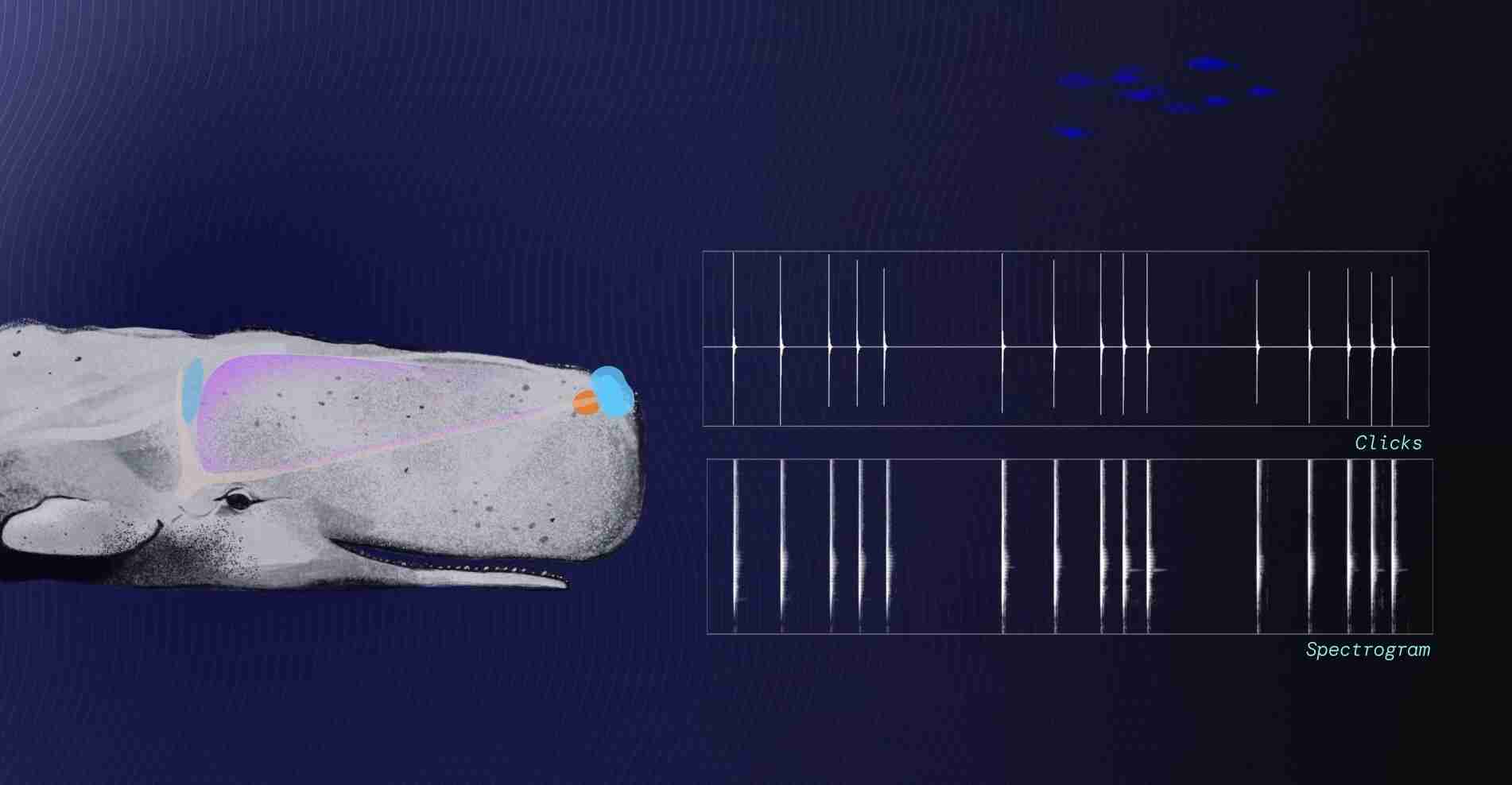
In human languages, vowels are slow-moving frequency patterns that help form words and carry meaning. Researchers found that some sperm whale calls share similar slow frequency modulations rather than being only brief, sharp clicks. The team highlights that these vowel-like acoustic properties indicate building blocks that could support expressive, flexible communication — a substantial shift from the idea that whale clicks are mere Morse code-style pulses (UC Berkeley).
Context: whale brains, social life, and conservation
Sperm whales have the largest brains of any animal and live in tight, long-lasting social groups — ecological and social factors that make complex communication plausible. Project CETI builds on decades of field work, including long-term studies like the Dominica Sperm Whale Project that have documented family ties and dialects (Project CETI / Audacious Project).
Conservation angle: Demonstrating structured, potentially meaningful communication could strengthen public and legal support for protections, influencing rules on shipping, noise pollution, and marine habitat protection. Project CETI argues that attempts to translate whale signals may help policymakers and the public appreciate whale cognition and motivate stronger environmental measures (Audacious Project profile).
What this does — and does not — prove
The research provides strong evidence that sperm whale vocalizations have structured acoustic features similar to vowels, but it does not claim that scientists have fully decoded whale meaning. Instead, the work shows that the building blocks of a complex communicative system may be present; decoding intent and semantics will require more data, experimental mapping to behavior, and caution (UC Berkeley statement).
Nationwide relevance and policy angles
For U.S. audiences, these findings intersect with federal science funding, marine protected area design, and noise pollution regulation. The interdisciplinary approach — combining biology, linguistics, and AI — aligns with national priorities and suggests practical spinoffs for ocean monitoring, undersea safety, and environmental data collection. Policymakers may weigh research funding, export controls, data sharing, and industry engagement as sensing technologies evolve (Project CETI).
Economic and legal impacts:
- Federal agencies like NSF and NOAA could use these results to guide interdisciplinary grants and programs.
- Evidence of sophisticated communication may bolster legal arguments for stricter protections and inspire expanded marine reserves or noise limits.
- Up-front engagement between scientists, industry, and regulators can smooth adoption of practical measures that balance conservation and livelihoods.
Public engagement, education, and regional impacts
The study offers material for educators, museums, and aquariums to teach about animal behavior, language, and AI. Public interest can drive private funding and nonprofit support; Project CETI already partners with public funders to scale research and outreach (Project CETI / Audacious Project).
Regional note: Coastal states with whale habitats may see direct effects from protections or research activities, with potential benefits to whale-watching economies and fisheries when science and policy are well-aligned.
Sources and further reading
- UC Berkeley news release: “UC Berkeley and Project CETI study shows sperm whales communicate in ways similar to humans”
- Project CETI overview on The Audacious Project
This article summarizes the UC Berkeley announcement and Project CETI materials to preserve methods, findings, and implications of recent research into sperm whale communication and whale language efforts.