SAN BERNARDINO, Calif., June 24 (Inland Empire News Online) — A peer-reviewed study from the University of Hawaiʻi at Mānoa says tectonic stress along the San Andreas and San Jacinto fault systems in Southern California has reached, and in some places exceeded, the highest levels seen in the past 1,000 years, a finding with direct implications for earthquake hazard in the Inland Empire and beyond.
The research, published in the Journal of Geophysical Research: Solid Earth, was led by Earth scientists at UH Mānoa. Lead author Liliane Burkhard is a research affiliate in the Hawaiʻi Institute of Geophysics and Planetology at the UH Mānoa School of Ocean and Earth Science and Technology and a scientist at the University of Bern in Switzerland.
The study reconstructs tectonic stress across the region over the past millennium and concludes that the fault system is now in a critically loaded state. In the authors’ view, the result adds to concern about a major earthquake on one fault or a rupture that could extend across both systems.
“Our results show that stress levels on multiple fault segments are now at or above the highest values seen in the past millennium and that the region may be capable of a large through-going rupture involving both fault systems,” Burkhard said in the university’s release.
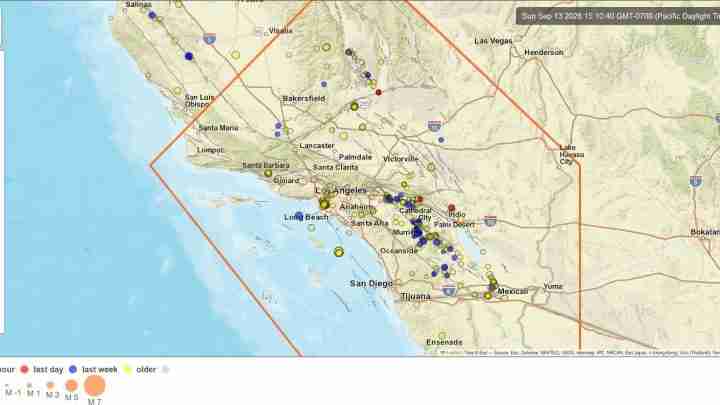
The study’s authors say the finding matters because the San Andreas and San Jacinto fault systems cut through a densely populated and infrastructure-heavy corridor in Southern California. The release cites possible effects on Los Angeles, San Bernardino, Riverside and the Coachella Valley.
Among the locations highlighted by the study is Cajon Pass, which the authors say could help link a rupture across both fault systems. The university said such a joint rupture could be significantly more damaging than a rupture on a single fault alone.
The study does not say an earthquake is imminent. Instead, it uses a long-term stress reconstruction to show that the region has reached a level of loading that the authors describe as historically high.
Burkhard said the load on the fault system remains elevated after more than 160 years since the last major rupture. “Right now, with stress at historically high levels across the region and more than 160 years elapsed since the last major rupture, the system is in a critically loaded state,” she said.
The research may be especially relevant for inland Southern California, where the San Bernardino and Riverside counties sit near the fault network studied by the team. The university said the results have direct implications for seismic hazard assessments in that corridor.
The study also gives specific modeled stress values for parts of the system. According to the research summary, stress reached 3.6 megapascals on the San Jacinto-Bernardino section, above the highest value seen in the 1,000-year simulation, and 2.8 megapascals on the Mojave South section of the San Andreas Fault.
Those numbers are important because they place present-day stress at the top end of the study’s long-term reconstruction. The authors used that comparison to argue that the system may now be positioned for a large rupture scenario involving both faults.
The Journal of Geophysical Research: Solid Earth study adds to a long-running scientific effort to understand how stress builds along major faults before earthquakes. In this case, the authors say the pattern they reconstructed is unusual because it shows multiple fault segments at or above their historical highs at the same time.
Southern California has experienced large earthquakes before, but the study focuses on the combined behavior of two major fault systems rather than on a single fault in isolation. The authors say that matters because a rupture that travels through more than one segment can spread shaking across a wider area and increase the damage potential.
The university release said the research was led by Earth scientists at UH Mānoa, underscoring the institutional role of the project as a scientific assessment rather than a government warning or emergency notice. The paper was peer reviewed before publication in the journal.
For residents and planners in the Inland Empire, the most immediate significance is not a forecast of when the next quake will happen, but the study’s conclusion that the fault network is now at a level of stress that has not been seen in the modelled record for about 1,000 years. The authors say that finding should inform how earthquake risk is assessed across Southern California’s urban and infrastructure corridors.