
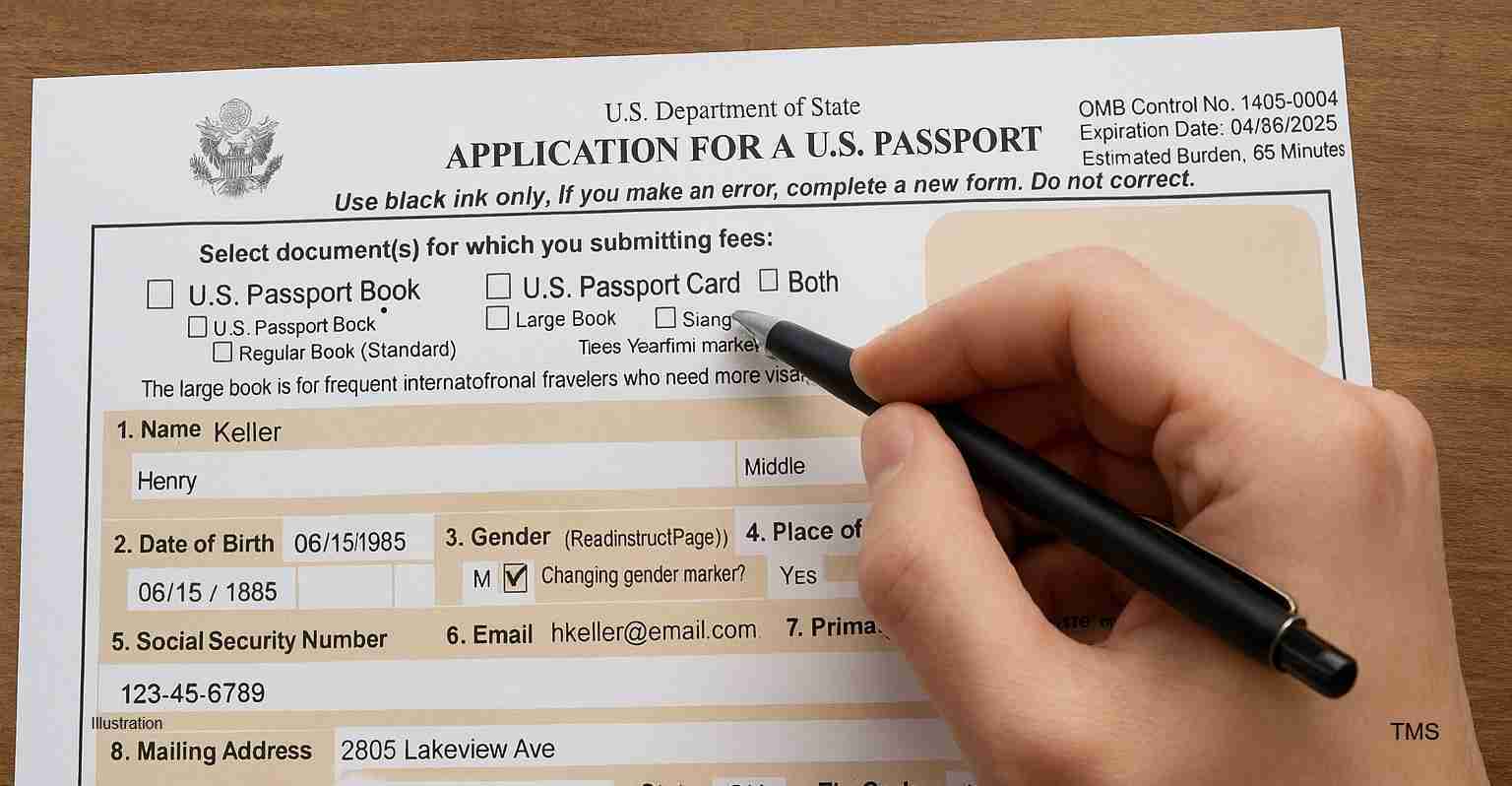
Supreme Court allows Trump to limit passport sex markers, blocking gender-identity choices for travelers
The Supreme Court temporarily allowed the Trump administration to enforce a policy requiring new U.S. passports to display sex assigned at birth, blocking options like gender-identity markers and an “X” designation while litigation proceeds abroad.
- Temporary stay: The Court permitted immediate enforcement of the State Department rule while challenges continue, according to the Supreme Court order and reporting from SCOTUSblog.
- Majority view: The unsigned majority described listing sex at birth as a factual attestation and compared it to recording country of birth (opinion).
- Dissent: Justice Ketanji Brown Jackson, joined by Justices Sotomayor and Kagan, warned the stay permits likely harm to transgender and nonbinary Americans (analysis).
- Practical effect: New and renewed passports will list sex assigned at birth; requests for gender-identity markers or an “X” are blocked while the case proceeds (ABC7; WABE).
Key information
What the order does: The Supreme Court issued a procedural stay that lets the Trump administration enforce a passport policy listing the sex assigned at birth while the underlying constitutional and statutory claims continue in lower courts. The text of the Court’s action is in the opinion, and legal coverage is available from SCOTUSblog.
The unsigned majority wrote that listing birth sex is “merely attesting to a historical fact without subjecting anyone to differential treatment,” and emphasized government interests in reliable identification and foreign-affairs consistency (Court opinion).
The dissent—by Justice Ketanji Brown Jackson and joined by Justices Sotomayor and Kagan—argued the stay allows concrete injury to transgender and nonbinary people “without adequate (or, really, any) justification,” urging attention to safety and dignity concerns (SCOTUSblog; opinion).
Background and timeline
In January 2025 President Trump issued an executive order directing federal agencies to use “male” or “female” markers tied to birth certificates and what the order described as biological classification; reporting and legal summaries discuss that order and its implementation (SCOTUSblog; Court opinion).
That policy reversed the 2021 State Department change under the Biden administration that allowed self-attestation for passport sex markers, including an “X” option, without requiring medical documentation (ABC7).
Seven plaintiffs — transgender and nonbinary Americans represented by civil-rights groups — sued the State Department, arguing the reversal deprived them of usable identification and increased risks of harassment or violence while traveling (ACLU statement; Lambda Legal).
What the Court said
Procedural posture: The stay is procedural: it permits enforcement of the administration’s passport sex-marker rule while litigation proceeds. The majority framed the display of sex at birth as a factual record-serving government interests in identification reliability and foreign-affairs consistency (Court document).
The Solicitor General defended the policy before the Court, arguing the president has broad authority over passport rules and that consistent sex markers support identification, foreign relations, and security (opinion; ABC7 coverage).
On the dissent: Dissenting justices emphasized the real-world harms the stay permits, including safety risks and indignities documented by plaintiffs and acknowledged by lower courts (SCOTUSblog).
Reactions from advocates, states and the administration
Civil-rights groups: The ACLU, Lambda Legal, and other organizations condemned the decision as discriminatory and warned it could increase risks for transgender and nonbinary travelers.
Supporters: Officials aligned with the administration and some conservative legal commentators praised the order as respecting executive authority over foreign-affairs-related identification standards and reducing document inconsistency (Politico).
Practical effects now in place
Effective immediately, U.S. passports issued or renewed will list the sex assigned at birth. Requests to change a passport sex marker to reflect gender identity or to use an “X” marker are blocked while litigation continues (ABC7; WABE).
Important for travelers: People with older passports that reflect their gender identity may face mismatched documentation if other IDs show different markers, raising the risk of questioning or worse in certain countries. Advocacy groups advise affected travelers to consult legal advocates and consular resources (ACLU).
Legal process ahead
The Supreme Court’s stay does not resolve the merits. Lower-court litigation continues, and the issue could return to the Supreme Court in a later, fuller briefing. For now the stay enables enforcement of the administration’s policy while constitutional and statutory claims proceed (SCOTUSblog; Politico).
Implications for the United States
- Economic & travel: Mismatched documents can cause delays, added costs, and complications for business and educational travel (ACLU).
- Political: The ruling spotlights executive authority over identification policy and may intensify legislative and state-level responses (Politico).
- Social: Advocates warn of increased safety risks for gender-diverse travelers in hostile jurisdictions (WABE).
Reporting and sources
This article draws on primary and secondary sources, including the Supreme Court opinion, SCOTUSblog analysis, Politico coverage, ABC7 reporting, WABE report, and statements from advocacy groups including the ACLU and Lambda Legal.



