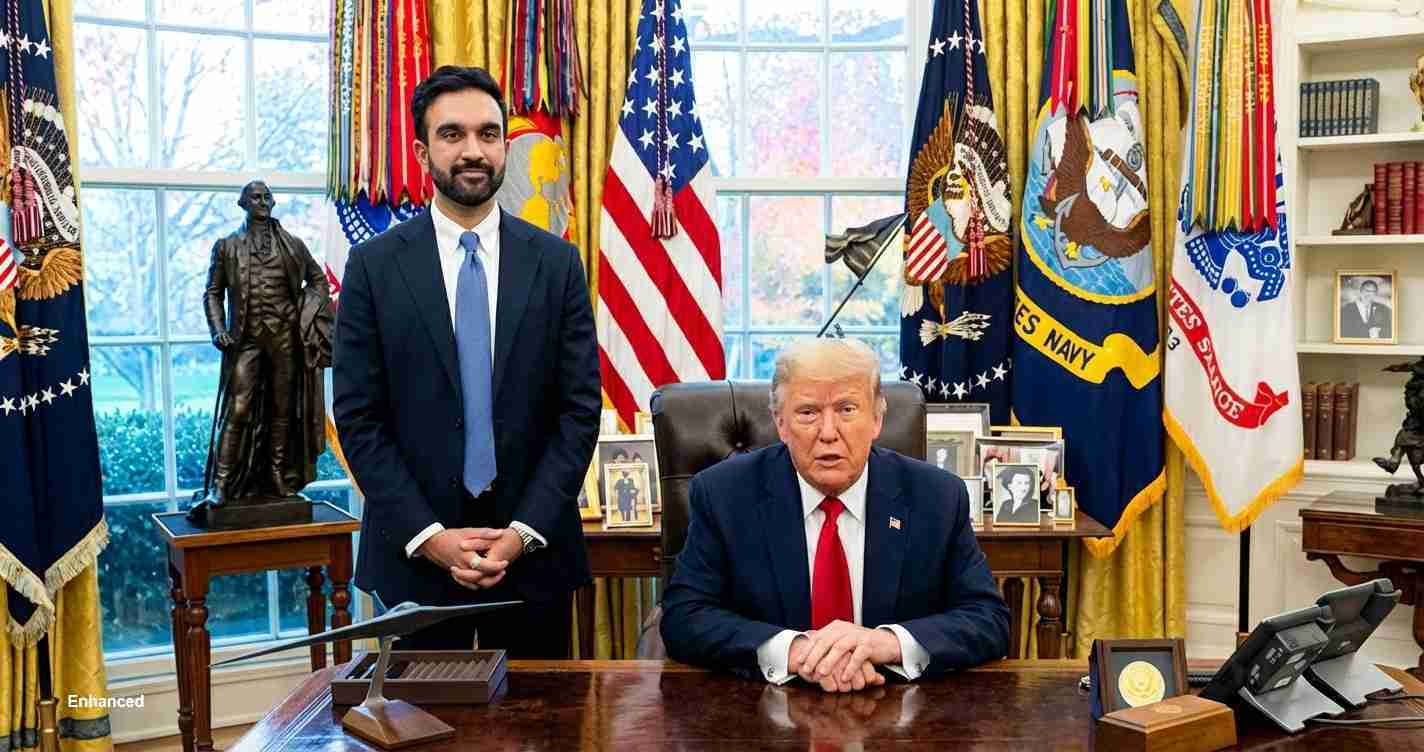
Trump, Mamdani Find Surprise Common Ground on Housing and Costs after Oval Office Meeting
In a surprising Oval Office meeting, President Trump and New York City Mayor-elect Zohran Mamdani set aside campaign hostilities to discuss affordability, housing supply, and energy costs, signaling a possible bipartisan push to lower living expenses for New Yorkers.
- Oval Office sit-down: A civil, sometimes cordial meeting focused on housing, energy and economic security (Video).
- Tonal shift: The meeting marked a step back from campaign attacks, including prior insults and promises to “Trump-proof” the city (Reporting).
- Shared priorities: Both leaders emphasized affordability, housing supply and working with Con Edison to lower energy bills (Video).
The meeting and tone shift
The Oval Office sit-down was short but symbolically large. Reporters observed two political rivals who had traded sharp words during the campaign adopt a working tone and a shared public agenda. Video of the exchange captures moments of mutual deference and an effort to focus on problem-solving (Video).
During the campaign, President Trump repeatedly attacked Mamdani with personal labels — calling him “my little communist mayor” and a “communist lunatic” — while Mamdani vowed to “Trump-proof” New York City and criticized federal policies he said harmed working New Yorkers (CBS News).
At one point a reporter asked Mamdani about past comments comparing Mr. Trump to a fascist; Mr. Trump interjected from the Resolute Desk, saying, “it is ok, you can just say yes, it is easier than explaining,” attempting to smooth the moment himself.
Shared priorities: affordability and housing
Affordability emerged as the central theme. Both men framed rising cost pressures as urgent problems voters want solved. Mamdani noted that despite “many disagreements with the president,” both were elected by people worried about affordability (Video).
Housing solutions topped the agenda. President Trump expressed hope to work with Mamdani to lower rents and increase housing supply by building more units and removing obstacles that make construction expensive and slow — a supply-side emphasis that aligns with market-oriented strategies to ease housing pressure (Video).
They also discussed energy costs and potential partnership with Con Edison to find ways to bring down monthly utility bills, which can offer immediate relief to households and enjoy bipartisan support (Video).
Policy specifics discussed
Officials did not unveil a full policy roadmap in public remarks, but the meeting raised several concrete ideas, including:
- Incentives and regulatory reform: Changes to speed housing construction and increase rental supply in New York City (Video).
- Utility engagement: Talking with Con Edison on rate structures, efficiency programs or relief measures to lower monthly bills (Video).
- Mutual pledge: Focus more on shared priorities — affordability, jobs, public safety — rather than public spats (Video).
Trump and federal funding
A notable shift involved federal dollars. Mr. Trump had at times hinted at withholding federal funds from New York City over political disputes; after the meeting he said withholding funds did not appear necessary, signaling a softer posture toward federal-city relations (Video).
For city leaders and residents, that reduction in risk could ease fears of sudden budget pressure from federal actions.
Mamdani’s perspective and protocol
Mamdani’s team described the meeting as partly a matter of protocol: meeting the president is customary for the leader of the nation’s largest city. They emphasized that Mamdani intends to pursue cooperation where it delivers results while continuing to oppose federal policies he deems harmful (Video).
Political implications and reactions
Observers highlighted the optics. For Republicans, a president finding areas of agreement with a Democratic mayor-elect complicates simple national narratives that portray Democrats as uniformly far-left. For Democrats, Mamdani’s willingness to meet and seek compromises may blunt attacks that label him extreme.
Midterm dynamics: Analysts warned the meeting could reshape messaging ahead of the 2026 midterms. If the president publicly backs practical measures to lower New Yorkers’ costs, Republicans may find it harder to use Mamdani as a national foil (Video).
Still, many cautioned against overstatement: one meeting does not erase months of rhetoric nor guarantee long-term alignment. The next steps — details of agreements, legislative work, and administrative cooperation — will determine whether tone becomes tangible policy.
Sources and documentation
Primary materials and reporting cited throughout this article:
- White House meeting video and remarks (YouTube)
- Additional remarks and context from Mamdani (YouTube)
- Reporting on prior exchanges and campaign rhetoric (CBS News)
Implications for the United States
Economic impact: A sustained federal-local partnership focused on lowering housing and energy costs could ease inflationary pressure on households in New York City and influence consumer spending more broadly. As a major economic engine, New York’s policy choices can affect national growth (Video).
Political consequences: The meeting narrows certain lines of partisan attack. If the president endorses practical measures that align with Mamdani’s priorities, partisan distinctions may blur and reshape messaging heading into 2026 (Video).
Social effects: Lower housing and energy costs would immediately benefit working families, seniors and renters; successful New York initiatives could spread to other metro areas and reduce cost-driven migration (Video).
Cultural relevance: The meeting signals renewed presidential engagement with city leadership across political differences, and may hint at a practical, problem-solving tone that appeals to moderates.
Conclusion
The Trump–Mamdani Oval Office meeting brought together two figures who publicly clashed and demonstrated that political rivals can still identify shared priorities. The real test will be whether the cooperation on video and in public remarks becomes measurable policy that eases costs for New Yorkers and serves as a model for other cities.