
Congress approves Trump’s signature ‘big beautiful bill’ after marathon debate
 Mike Johnson big beautiful bill (Courtesy Wikipedia)
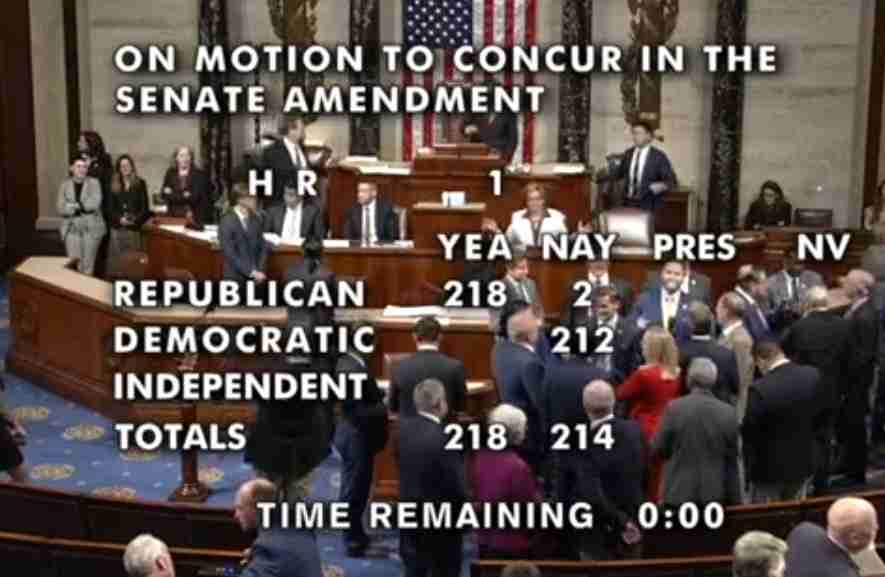
Washington, DC (Times Media Service) – President Trump’s “big beautiful bill” finally cleared Congress early Thursday after a tense, 29-hour marathon session that saw Senate Republicans fend off amendments and secure a razor-thin 51–50 victory with Vice President JD Vance casting the tie-breaking vote to advance the landmark budget reconciliation package—only to have the House swiftly concur later that day with a 218–214 vote, sending the legislation to the president’s desk on its July 4 deadline.
Overnight Battle in the Senate
Senate Republicans locked themselves in for an all-night “vote-a-rama,” debating hundreds of proposed amendments well into the pre-dawn hours to preserve the core elements of President Trump’s “big beautiful bill.”
With the chamber deadlocked at 50–50, the White House had staked its credibility on getting the package across the finish line by July 4.
Vice President JD Vance emerged at 2:17 a.m. to cast the decisive vote, making permanent the individual tax cuts from 2017 and enacting new provisions on tips and overtime deductions.
Senate Majority Leader John Thune called the outcome “a win for families, farmers, and our national security,” even as three Republicans—Thom Tillis, Susan Collins, and Rand Paul—joined Democrats in opposition over concerns about Medicaid cuts and debt increases.
Road to Passage in the House
Earlier parliamentary maneuvering used the budget reconciliation process, allowing the upper chamber to bypass a 60-vote filibuster threshold and approve the bill with simple majorities.
On Thursday afternoon, the House voted 218–214 to agree to the Senate amendments, despite warnings from Speaker Mike Johnson that changes undercut the chamber’s original provisions.
The final tally reflected narrow GOP majorities in both chambers and underscored intra-party divisions between moderates wary of health-care cuts and hardliners demanding deeper spending reductions.
Key Provisions of the Big Beautiful Bill
The legislation extends $4.5 trillion in tax cuts over ten years, including permanent retention of Trump’s 2017 individual rate structure and a new deduction eliminating federal income tax on tips and overtime pay for workers earning under $150,000.
It allocates $150 billion each for defense and border enforcement, boosting ICE’s budget more than tenfold and funding a new Arctic icebreaker fleet to counter Chinese and Russian advances.
Medicaid and SNAP face $1.1 trillion in cuts, with new work requirements, higher co-pays, and tighter eligibility checks that could strip coverage from up to 11 million low-income Americans.
Clean-energy incentives are curtailed: wind and solar tax credits begin phasing out in 2026, and electric vehicle deductions end by September 2025, prompting industry warnings of stalled investment.
Reactions Across the Nation
Critics from both parties decried the bill’s impact on vulnerable populations. The Congressional Budget Office forecasts 10.9 million more uninsured by 2034, deepening health inequities—particularly in rural and minority communities.
On “The Breakfast Club,” Charlamagne Tha God warned that the GOP’s willingness to push through such an unpopular measure signals confidence in rigged elections ahead.
Investor sentiment was mixed: financial markets dipped on concerns over ballooning deficits, though defense-contract stocks rallied on the $150 billion spending increase.
Meanwhile, corporate America celebrated tax relief: private equity firms, oil producers, and defense contractors stand to gain billions, while clean-energy and tech companies lament lost incentives.
Impact on Americans
Farmers and manufacturers welcome expanded deductions for U.S.-assembled car buyers and new agricultural tax credits, potentially lowering production costs in the Midwest and South.
But rural hospitals face uncertainty despite a $50 billion Rural Hospital Fund boost, as Medicaid reimbursement cuts threaten operating margins in under-served regions.
Low-income families relying on SNAP will see benefits trimmed by $9 billion over the next decade, forcing some to turn to local food banks already stretched thin.
Retirees aged 65+ can claim a temporary $6,000 deduction, reducing Social Security tax burdens for many, though experts caution it’s not a full exemption.
Reactions to the Big Beautiful Bill in the U.S.
Nationwide rallies erupted as advocacy groups decried the cuts to health care and nutrition programs; in Washington, activists vow legal challenges on Medicaid defunding provisions.
A poll by ABC News/Ipsos shows only 38% of Americans support the bill, with 54% opposed, marking one of the least popular major laws in recent decades.
GOP strategists argue the legislation will energize the conservative base ahead of the 2026 midterms, framing it as a fulfillment of Trump’s campaign promises.
Moderate Republicans fear backlash in suburban districts, especially among women of color concerned about reproductive-health provisions blocking Medicaid payments to clinics.
Robert Stine / Editor Writer (Times Media Service)
Founder of Times Media Service & Stine Strategies. Over two decades in marketing, media & advertising strategy. MBA in Marketing.
rstine@timesmediaservice.com



