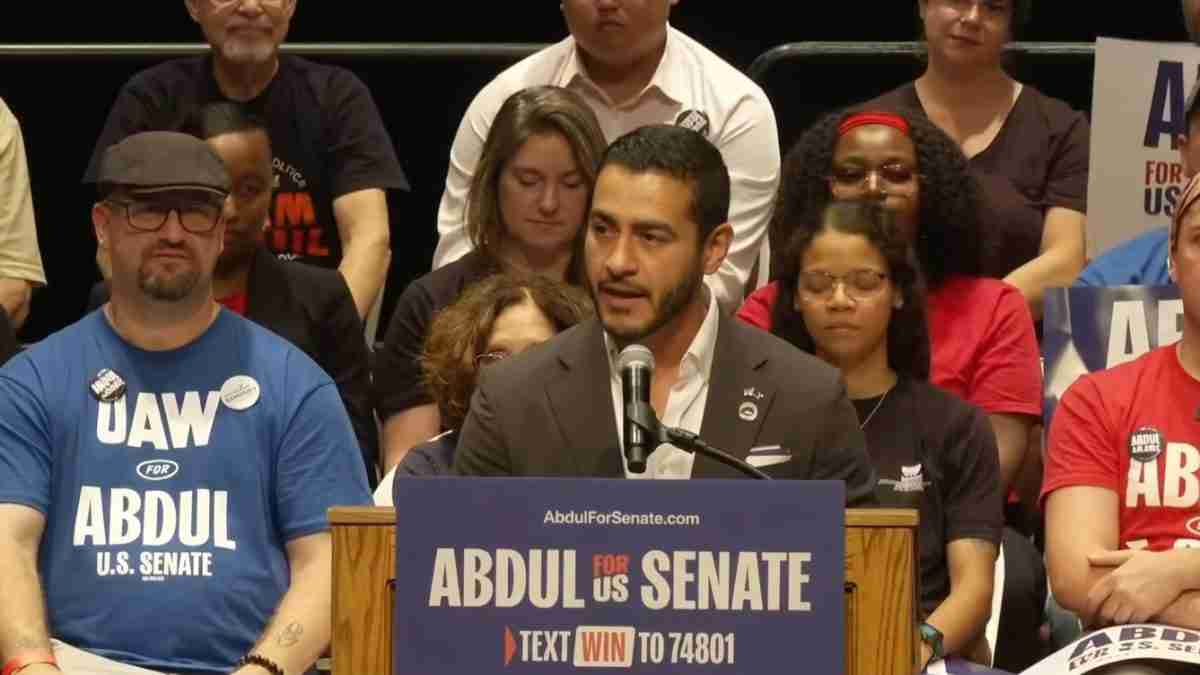
LANSING, Mich., July 24 (Our Michigan Times) — With Michigan’s Aug. 4 Democratic primary approaching, the state’s U.S. Senate race has picked up an unusual wrinkle: some Jewish Democrats and fundraisers say they would vote for Republican Mike Rogers if Abdul El-Sayed becomes the Democratic nominee.
The primary will decide which Democrat moves on to the fall race. Rogers, a former U.S. House member, is the likely Republican nominee.
What is driving the concern?
The reporting centers on El-Sayed’s views on Israel. In interviews with Jewish donors and activists, several said his criticism of Israel makes them uneasy about supporting him in a general election.
That concern has led some donors to talk openly about Rogers as a backup option.
Dennis Bernard, the Jewish Federations of North America’s national chair of government relations, said there are Jewish community leaders who are longtime Democrats and Democratic fundraisers and who would support Rogers “both financially and with their vote” if El-Sayed wins the primary.
Another Jewish Democrat, retired commercial mortgage banker Neil Gorosh, said, “If it came down to Mike Rogers and El-Sayed, I will vote for Mike Rogers.” Gorosh said he would not donate to Rogers, but would encourage like-minded friends to do the same.
What does “hedge” mean here?
In this race, “hedge” means some donors are not saying they have changed parties for good. Instead, they are signaling that if El-Sayed is the nominee, they may support Rogers to keep their options open in a race they see as especially important.
That does not mean every Jewish Democrat agrees. The reporting describes a group of donors and fundraisers, not a formal bloc.
What are the candidates saying?
Rogers has made clear he thinks the Democratic primary matters to his own chances. On a supporter call reported by CNN, he said, “If he wins, I think we’re in a favorable position,” and later added, “I think our chances improve if he becomes the nominee.”
Rogers campaign spokesperson Alyssa Brouillet said, “We’re well-positioned to triumph over both of them.”
Stevens campaign spokesperson Arik Wolk said Rogers had “acknowledged what Republicans have claimed for weeks: they believe they can defeat Abdul El-Sayed.”
What is still unknown?
The reporting does not show how many Jewish donors are involved, how much money might be redirected, or whether any public fundraising records already reflect a shift to Rogers.
It also does not show that these comments represent all Jewish Democrats in Michigan. They reflect the views of the people interviewed.
Why does this matter?
Michigan is a closely watched Senate battleground, and the Democratic nominee will likely face a strong Republican challenge.
If El-Sayed wins the primary, the race could become a test not just of party loyalty, but also of how much Israel policy shapes voting and fundraising decisions among some Jewish Democrats in Michigan, especially in Metro Detroit.
For now, though, the immediate decision is still the primary. The state’s Democratic voters will choose the nominee on Aug. 4, and only then will the fall matchup be set.