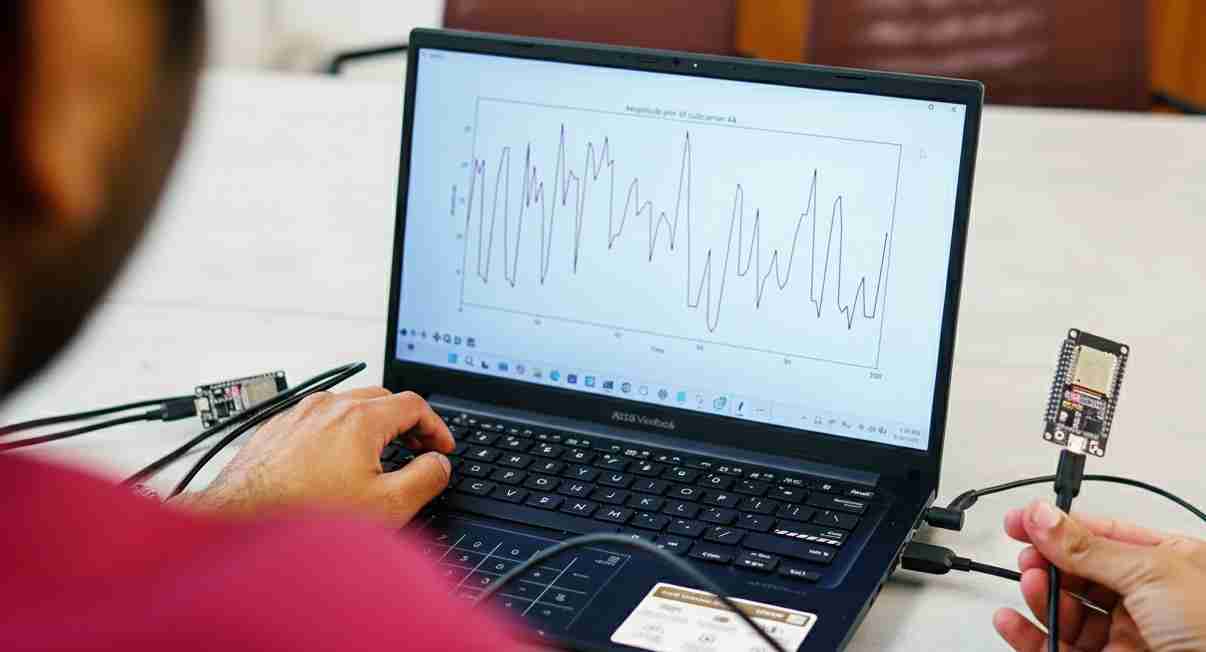
Pulse‑Fi: How Wi‑Fi Signals Can Monitor Your Heartbeat — A Contactless Step Toward Affordable Home Health
Researchers at the University of California, Santa Cruz have developed Pulse‑Fi, a system that uses ordinary Wi‑Fi signals and machine learning to contactlessly measure heart rate, promising affordable, accurate remote monitoring without wearables for home and clinical settings.
Key takeaways
- Contactless sensing: Pulse‑Fi uses standard Wi‑Fi transmitters and receivers to detect tiny radio variations caused by the beating heart, as described in the UCSC news.
- Machine learning: Neural networks separate heartbeat signals from movement and noise to achieve clinical‑level accuracy, per coverage in Tom’s Hardware.
- Low cost: Hardware such as ESP32 chips and Raspberry Pi units keep device costs down, enabling widespread, inexpensive deployments (Tom’s Hardware; UCSC news).
- Performance: Lab tests show reliable detection up to ~10 feet and mean errors near 0.5 beats per minute in controlled conditions (UCSC news; Tom’s Hardware).
Main content
How Pulse‑Fi works
Pulse‑Fi treats Wi‑Fi waves like a light beam that is subtly bent and absorbed as it passes through the body. Each heartbeat causes minute chest motion that changes reflected and transmitted radio signals just enough for sensitive receivers to detect.
Because raw Wi‑Fi data are noisy, the UCSC team paired Wi‑Fi signal changes with synchronized pulse oximeter “ground truth” readings and trained neural networks to map signal patterns to beats per minute. This approach helps the system filter out coughs, posture shifts, other people moving, and environmental changes (UCSC news; Tom’s Hardware).
The approach isolates heartbeat signatures from environmental and motion noise by leveraging a paired dataset of Wi‑Fi measurements and pulse oximeter readings.
Technical details and performance
Pulse‑Fi runs on low‑cost hardware: ESP32 microcontroller chips (roughly $5–$10) and Raspberry Pi single‑board computers can collect the necessary signal data for inference, making the system far cheaper than many medical monitors and high‑end wearables (Tom’s Hardware; UCSC news).
In laboratory tests the system closely matched pulse oximeter readings, reporting mean errors around half a beat per minute under controlled conditions and reliable detection at distances up to about 10 feet. The researchers report that machine learning filters out background motion that limited earlier radio‑based approaches (Tom’s Hardware; ZME Science).
Clinical and biomedical significance
Contactless pulse monitoring could broaden access to continuous health data. Pulse‑Fi requires no wearable, which is attractive for elderly people who forget or refuse devices, newborns or patients with fragile skin, and low‑resource settings where device cost and maintenance are barriers (UCSC news; Earth.com).
Beyond heart rate, radio‑based sensing can detect breathing and chest motion, pointing to possible screening for respiratory rate and sleep disorders such as sleep apnea. Pulse‑Fi joins a global body of work that uses Wi‑Fi Channel State Information (CSI) and radar sensing for biomedical applications (PubMed review).
Limitations and challenges
Pulse‑Fi remains a research system, not a commercial medical device. It has been evaluated in controlled environments; broader validation across ages, body types, housing materials, and clinical conditions is required. Regulatory approval, larger clinical trials, and rigorous performance testing are necessary before deployment in medical settings (UCSC news; ZME Science).
Privacy and security are central concerns: contactless sensing shifts risk from a wearable device to in‑room monitoring, raising questions about consent, data retention, misuse, and potential surveillance in workplaces or rental housing (PubMed review).
Applications and future directions
Near‑term pilots could include passive monitoring in senior living facilities, non‑intrusive monitoring in hospitals, and low‑cost screening in clinics with limited resources. Over time, models may expand to detect respiratory rate, atrial fibrillation patterns, or sleep disturbances, provided accuracy, privacy, and interoperability are addressed (UCSC news).
Implications for the United States
Economic: Low hardware costs for ESP32 chips and affordable single‑board computers suggest widespread, low‑cost deployment that could reduce monitoring expenses for remote care programs and shift some care from hospitals to homes (Tom’s Hardware; UCSC news).
Policy and regulation: Policymakers must consider standards for accuracy and safety, likely involving the FDA for medical claims, plus rules for data use, consent, and retention to prevent misuse outside medical contexts (PubMed review).
Social and cultural: Contactless monitoring can reduce the burden of wearables for patients and caregivers, but acceptance will hinge on privacy safeguards, transparent communication, and preserving choice and consent (Earth.com).