Scientists say Easter Island mystery solved — Moai statues “walked” upright, matching Rapa Nui oral traditions
Scientists say long-standing mystery solved: Easter Island’s moai were transported upright by ‘walking’ them with ropes and coordinated teams, a method supported by digital models, replica experiments and Rapa Nui oral traditions that described the statues as moving.
Key takeaways
- Walking method confirmed: Digital models and physical trials show moai could be rocked and pivoted upright using ropes and small teams, relying on pendulum dynamics.
- Small teams, low impact: Tests indicate as few as 15 people for initial moves (and up to ~60 for larger tasks); a team of 18 moved a replica 328 feet in 40 minutes.
- Design matters: D-shaped bases and a forward center of mass made controlled rocking possible; unfinished statues at quarries support planned transport.
- Cultural validation: The findings align with Rapa Nui oral traditions that the statues “walked,” reframing such accounts as practical knowledge rather than mere myth.
Main story
How the researchers tested the “walking” idea
A team led by anthropologists including Carl P. Lipo and Terry L. Hunt combined computer simulations, physics modeling and field experiments to evaluate how moai could be moved upright. Digital modeling showed the statues’ D-shaped cross-sections and slightly forward center of mass favor a controlled rocking motion when ropes pull the head or neck.
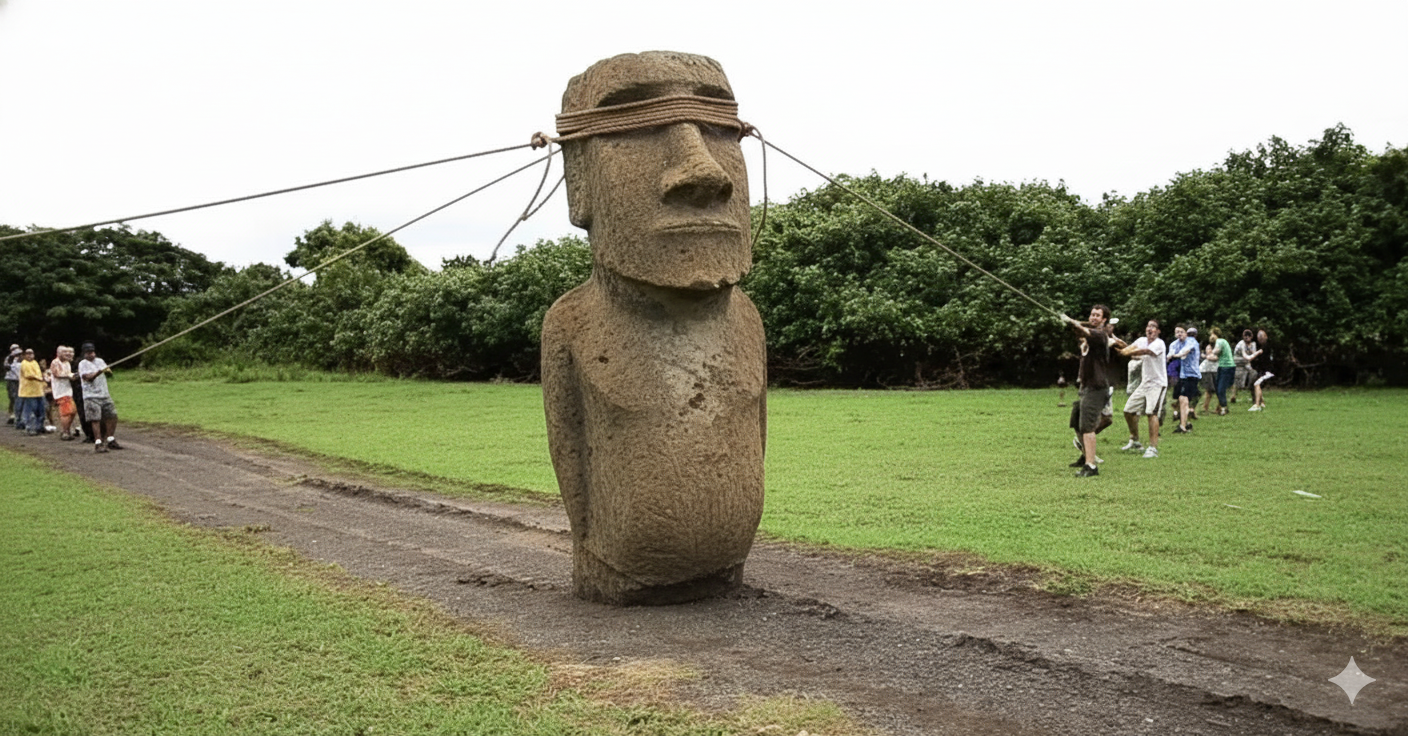
Once tipped and set in motion, a moai behaves like a pendulum: inertia reduces the energy needed to keep it moving compared with the initial effort to tip it. In lab and field trials, teams attached ropes to the head or shoulders and coordinated short pulls and side-to-side motions. The statue pivots forward a few degrees, then rights itself — repeating this controlled zigzag to advance.
“The motion is slow but steady: average walking speeds measured near 1,000 feet per hour, allowing movement of statues several miles over days without massive timber or large labor forces.”
A publicized field test showed practical results: a team of 18 people moved a full-scale replica 328 feet in 40 minutes, a demonstration the authors cite as faster and less resource-intensive than earlier theories relying on rollers or sleds.
Sources documenting the experiments and simulations include Live Science, Local 12 and the researchers’ publication summary at the University of Arizona experts page.
Why the statues’ design mattered
The research argues that many moai were deliberately carved with a D-shaped base and a slight forward lean to lower the center of mass, making controlled rocking easier. Incomplete statues left along island roads — often standing upright in stages of carving — suggest builders planned transport during carving at the Rano Raraku quarry.
Placement on raised stone platforms (ahu) and pathways radiating from the quarry match a strategy of moving finished pieces upright to final sites. The authors suggest this approach reduced the need to fell large trees for rollers or sleds, challenging theories that statue transport directly caused widespread deforestation and ecological collapse on Rapa Nui.
Alignment with Rapa Nui oral traditions
For generations, Rapa Nui oral histories described the moai as having “walked” to their platforms. While scholars often dismissed such accounts as myth, the new physical explanation validates the oral record: coordinated rope techniques could produce a walking motion.
Recognizing indigenous knowledge matters: the study emphasizes that local narratives can reflect practical engineering practices developed and refined over generations, and that such traditions deserve respectful integration into archaeological interpretation.
Technical takeaways for archaeologists
- Pendulum dynamics: Once rocked, inertia helps carry the motion forward, lowering energy needs for each step.
- Team size and efficiency: Small, coordinated teams — sometimes as few as 15 for initial moves and up to 60 for larger operations — are sufficient, reframing assumptions about labor organization.
- Archaeological traces: Upright unfinished statues and ahu placements align with a strategy of walking finished pieces from quarry to platform.
Broader implications and implications for the United States
Beyond Easter Island, the research reframes how scholars should weigh indigenous knowledge alongside physical evidence. Techniques once dismissed as folklore may reflect sustained technological practice. If moai were moved with fewer resources than previously thought, narratives linking statue-making directly to environmental collapse need careful re-examination.
Implications for the United States
- Cultural respect and scholarship: U.S. museums and universities studying Pacific collections may re-evaluate exhibit narratives and highlight Rapa Nui engineering rather than dismiss oral traditions as myth.
- Academic funding: Grant priorities may shift toward projects integrating traditional knowledge with experimental methods, influencing funding for fieldwork and modeling.
- Education and outreach: The moai story provides teaching moments for physics (center of mass, pendulum motion) while honoring cultural narratives.
- Conservation and tourism: U.S. cultural sites can model sustainable interpretation of ancient technologies to balance preservation with visitor experience.
- Legal and ethical: Validating oral histories strengthens arguments for consulting native communities in research, repatriation, and co-stewardship decisions.
Sources and further reading
- Live Science
- ScienceDaily
- Popular Mechanics
- Local 12
- Fox News Travel
- Research authors’ work (University of Arizona experts)
Times Media Service — This reporting synthesizes the authors’ paper in the Journal of Archaeological Science with publicized experiments and multiple journalistic summaries to present a cohesive account of how the moai could have “walked” and the cultural significance of that conclusion.