
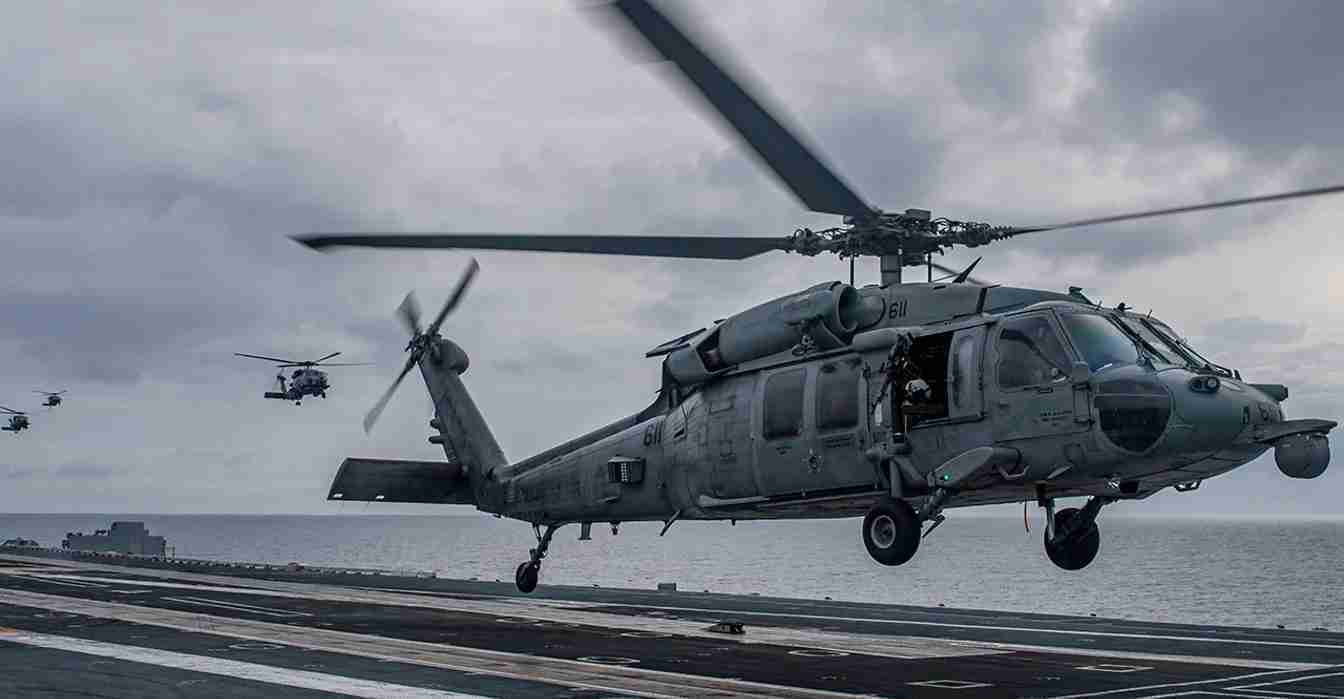
Two US Navy aircraft — Sea Hawk helicopter and F/A-18F Super Hornet — go down in separate South China Sea incidents; all crew rescued
On Oct. 26, 2025, a US Navy MH-60R Sea Hawk and an F/A-18F Super Hornet operating from USS Nimitz crashed in separate incidents in the South China Sea; all five crew were rescued and are reported in stable condition.
Key takeaways
- Two separate mishaps occurred during routine operations from USS Nimitz on Oct. 26, 2025; an MH-60R Sea Hawk at ~2:45 p.m. and an F/A-18F Super Hornet at ~3:15 p.m.
- All five crew rescued — three from the Sea Hawk and two from the Super Hornet — recovered by carrier strike group search-and-rescue teams and reported stable.
- No evidence of hostile action or midair collision has been reported; both aircraft were conducting scheduled operations when they went down.
- Investigations are underway to determine causes including mechanical, maintenance, or human factors; public updates have been limited amid a U.S. government shutdown.
Main content
What happened: timeline and immediate response
At about 2:45 p.m. local time on Oct. 26, an MH-60R Sea Hawk assigned to Helicopter Maritime Strike Squadron 73 (HSM-73 “Battle Cats”) experienced a mishap and went into the water while operating from USS Nimitz in the South China Sea. Roughly 30 minutes later, an F/A-18F Super Hornet from Strike Fighter Squadron 22 (VFA-22 “Fighting Redcocks”) crashed during routine flight operations; both pilots ejected and were recovered.
Carrier strike group search-and-rescue teams responded rapidly to both scenes and recovered all five sailors. Reports emphasize no hostile action was involved and there are no indications the aircraft struck one another.
“All five crew members were rescued and are reported to be in stable condition,” according to carrier strike group reports and media accounts.
Rescue and medical status
Carrier medical teams evaluated the rescued sailors aboard the carrier; media sources report they are in stable condition. The Navy has not released individual names or detailed medical reports pending family notifications and completion of initial inquiries.
Aircraft, squadrons and ship involved
The MH-60R Sea Hawk is a multi-mission naval helicopter used for anti-submarine warfare, surface warfare and search-and-rescue; the helicopter belonged to HSM-73 (“Battle Cats”). The F/A-18F Super Hornet is a two-seat strike fighter from VFA-22 (“Fighting Redcocks”). Both squadrons are based in California. The aircraft launched from and were recovered by the aircraft carrier USS Nimitz (CVN-68).
Investigations and official statements
The Navy has opened mishap investigations into both accidents. Investigators will examine flight data, maintenance logs, crew interviews and recovered wreckage. At this stage the causes remain unknown. Official public updates have been limited; primary information so far has come from U.S. Pacific Fleet social posts and defense reporting.
Operational context: Nimitz deployment and the South China Sea
USS Nimitz departed the United States in March 2025 for a routine Indo-Pacific deployment and was leading Carrier Strike Group 11, nearing what is expected to be its final operational deployment. The South China Sea is a contested and closely watched maritime area; carrier operations there are routine but politically sensitive.
Broader safety, readiness and policy implications
The near-simultaneous loss of two aircraft raises questions about maintenance, readiness and operational tempo. Analysts will assess whether fleet age, supply-chain pressures, or training and maintenance practices played a role. If systemic issues are identified, potential outcomes include changes to funding priorities, deployment cycles, and maintenance protocols.
For policymakers and the public: swift, transparent investigations will be important to preserve confidence; at the same time, the quick rescue response highlights the Navy’s search-and-rescue capabilities.
Family and personnel concerns
Both squadrons are California-based; families and local communities will closely follow recovery and investigation developments. The Navy’s casualty assistance and support networks are engaged to notify and support families as needed.
Information flow and the government shutdown
Public briefings and staffing for routine public affairs have been limited amid a U.S. government shutdown. The Navy posted initial notices on U.S. Pacific Fleet social channels, while detailed press briefings have been delayed, complicating the information flow to families and the public.
Sources and reporting
Investigations are ongoing. Journalists will update this report as the Navy releases formal findings, maintenance records, or other official statements.



