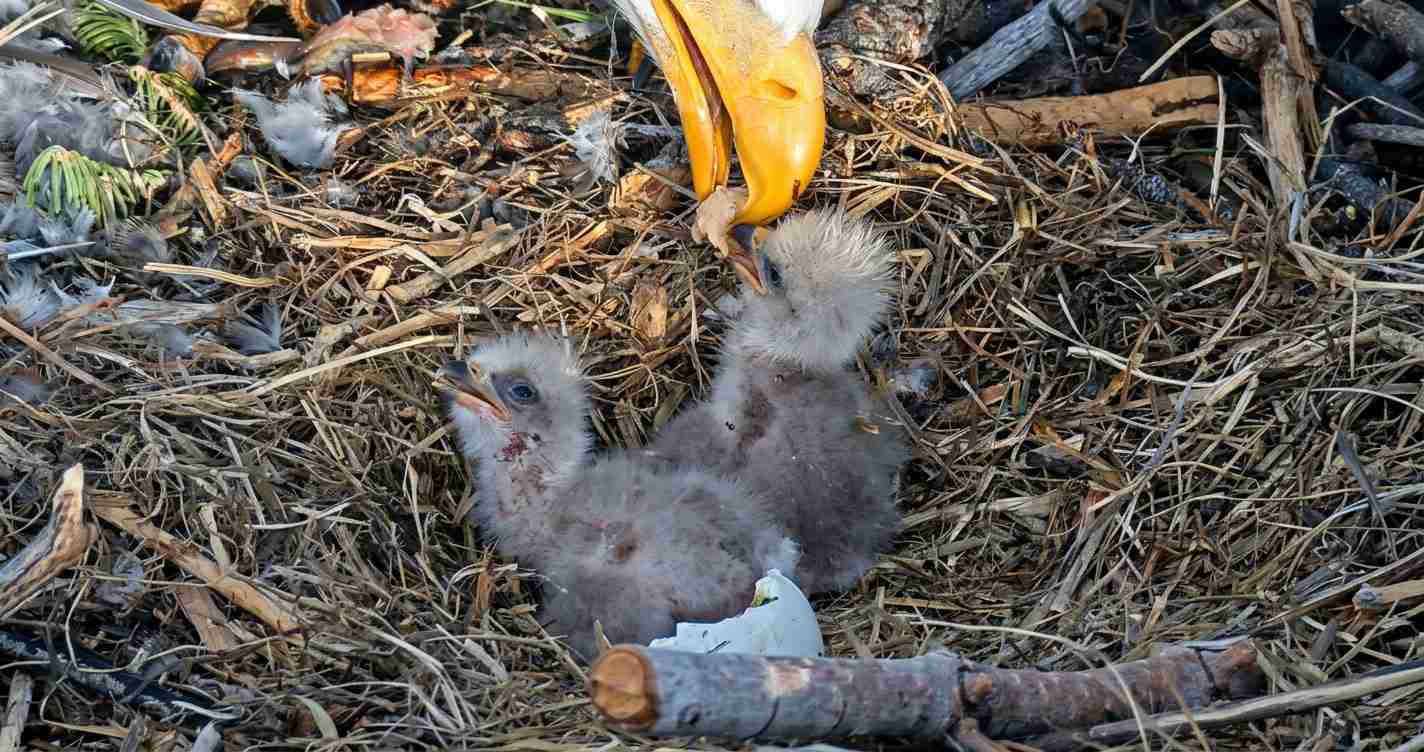
Big Bear bald eagles hatch: Jackie and Shadow welcome two new eaglets at Big Bear Valley eagle nest
Big Bear Lake, CA — Big Bear’s celebrated bald eagle pair, Jackie and Shadow, hatched two eaglets this weekend, with the first emerging Saturday night and the second early Sunday — a successful outcome after earlier egg losses in the season.
- Parents: Jackie and Shadow, the well-known nesting pair at Big Bear Lake.
- Hatch timing: First eaglet ~9:30 p.m. Saturday; second just before 9 a.m. Sunday (~12 hours later). Source: Fox 11 Los Angeles.
- Clutch history: Jackie laid four eggs; two were lost in a raven raid. A second clutch (Feb. 24 and Feb. 27) produced the two successful hatchlings. Sources: Fox 11 Los Angeles; ABC7.
- Livestream & public interest: Friends of Big Bear Valley’s continuous stream has drawn viewers and educational engagement since 2018. Background: Jackie and Shadow (Wikipedia).
Hatching timeline and what the livestream revealed
The Friends of Big Bear Valley livestream offered a real-time view of the hatching sequence. On Friday observers noted an external pip and audible chirps via the nest microphone — early signs that a chick had broken the internal membrane.
At approximately 9:30 p.m. Saturday the first eaglet fully emerged. The second completed hatching just before 9 a.m. Sunday, roughly 12 hours later. Viewers watched an adult shelter the hatchlings under its feathers shortly after daylight, demonstrating immediate parental care (Fox 11 Los Angeles).
Understanding pipping and early development
Friends of Big Bear Valley explained that pipping is when a chick cracks the internal membrane and takes its first breath; full emergence from the shell can take 24–48 hours after the first pip. The livestream allowed viewers to hear chirps and observe parental responses as the chicks transitioned from egg to nestling (Fox 11 Los Angeles).
Growth note: FOBBV reports eaglets can reach about three feet in size within roughly two months after hatching.
This season’s setbacks and recovery
Early in the season the nest was raided by ravens, destroying two of four eggs. After that loss, Jackie produced a second clutch on Feb. 24 and Feb. 27, and the two hatchlings this weekend came from that second clutch — a testament to the pair’s resilience and the value of continued monitoring (Fox 11 Los Angeles; ABC7).
Jackie and Shadow’s breeding history and public profile
The pair have been monitored publicly since Friends of Big Bear Valley began full-time streaming in 2018. They’ve successfully raised eaglets in previous years, including 2019 and 2022 — with continued public attention and additional offspring noted in 2025. Background and streaming history are summarized on Wikipedia.
Public engagement, education and management implications
The livestream functions as a virtual classroom: volunteers and staff explained terminology like “pip,” set expectations for hatching timing, and documented parental care. This transparency supports volunteer-led conservation and helps inform local managers considering targeted protections.
“Monitoring and open updates create an evidence trail managers can use to assess threats and frame conservation actions,” said observers monitoring the nest.
Implications for the United States
Economic: High-profile nests can modestly boost local tourism, donations, and online engagement.
Political & social: Stories like Jackie and Shadow’s often encourage community-based, practical conservation measures that appeal across political lines and foster volunteerism and civic education.
Practical applications for residents and managers
- Maintain respectful distances from nests and follow seasonal access guidelines.
- Support local organizations that monitor nests and provide education.
- Report suspected threats to local wildlife authorities.
- Consider habitat improvements—preserve perch trees and foraging areas.
Ongoing observations and what to watch next
The eaglets will remain dependent on Jackie and Shadow for food and thermoregulation. Observers will monitor feeding behavior, sibling interactions, and growth milestones over the coming weeks. Continued livestreaming will collect behavioral data while keeping the public informed (Fox 11 Los Angeles).
Sources and further reading
Key reporting and background: Fox 11 Los Angeles; ABC7; background summary at Wikipedia.