
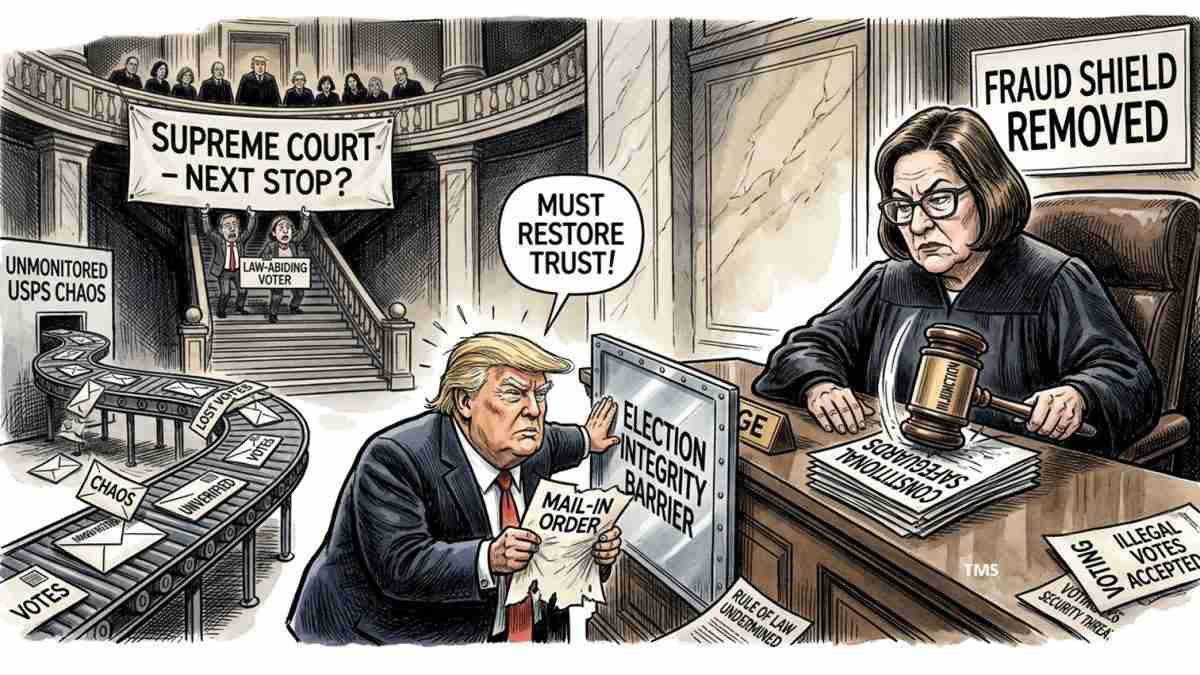
WASHINGTON, Aug. 28 (Nationwide Times) — A federal judge has temporarily stopped the U.S. Postal Service from enforcing new mail-ballot requirements tied to President Donald Trump’s executive order, putting the policy on hold as states prepare for the 2026 midterm elections.
U.S. District Judge Indira Talwani issued a 14-day temporary restraining order. The order temporarily restores a nationwide block on the Postal Service’s implementation of the plan. Talwani scheduled a hearing for Sept. 3 on whether to issue a longer-lasting injunction.
The case is part of a broader legal fight that includes lawsuits filed in federal court in Washington, D.C., by Democratic-led states, voting-rights groups and the Democratic Party. The latest order was issued by Talwani in the U.S. District Court in Boston.
What would the Postal Service have to do?
The Postal Service’s final rule, issued Aug. 21, would require states to provide lists of voters eligible to receive mail ballots. It also would require the use of a specific envelope format that had been reviewed and assigned a unique barcode.
The requirements stem from Trump’s March executive order, which sought to create a federal voter list and give the Postal Service a role in election-related operations. States and voting-rights groups challenged the plan, arguing that the federal government was exceeding its authority and that the requirements could disrupt election administration.
The litigation concerns the Postal Service’s actions, as well as the administration’s broader effort to change how mail voting is handled. State governments generally administer elections, while the Postal Service delivers ballots and other election materials.
Why did Talwani issue a new order?
Talwani’s latest order followed the Postal Service’s publication of its final rule. That publication restarted the legal challenge after earlier court action in the case.
Talwani wrote that states did not have enough time or money to redesign mail ballots, obtain approval for new designs, produce the ballots, update election systems, train election workers and upload voter information before the midterms.
Before issuing the latest temporary restraining order, Talwani had lifted an earlier nationwide preliminary injunction after concluding that a Supreme Court procedural ruling required her to reconsider it. The new order addresses the Postal Service’s final rule while the legal challenge continues.
What did the Supreme Court decide?
The Supreme Court previously issued an unsigned procedural order that paused or vacated an earlier Talwani injunction. The justices did not decide whether Trump’s executive order is lawful.
The Supreme Court said its action did not mean that every government measure taken to implement the executive order would necessarily be lawful. The court left the underlying legal questions for further proceedings.
That distinction matters because the Supreme Court’s earlier action affected the timing and scope of Talwani’s injunction but did not settle whether the administration can require the Postal Service to carry out the new procedures.
How did the dispute reach this point?
Trump issued the executive order in March. In May, U.S. District Judge Carl J. Nichols, in Washington, D.C., declined to immediately block it, finding that such action was premature because the Postal Service had not yet issued its rule.
In June, Talwani issued an injunction covering 23 mostly Democratic-led states and Washington, D.C. On July 1, U.S. District Judge Emmet Sullivan, also in Washington, D.C., separately blocked the Postal Service from implementing the plan nationwide. Sullivan cited a 2020 settlement involving the agency.
Talwani issued another nationwide injunction on Aug. 11. The Supreme Court’s procedural ruling on Aug. 24 affected that earlier injunction. After the Postal Service issued its final rule on Aug. 21, challengers returned to court, leading to Talwani’s latest temporary order.
What happens next?
The Sept. 3 hearing will address whether the temporary block should be replaced with a longer-lasting injunction. The administration or challengers may ask federal appeals courts to intervene, and the dispute could return to the Supreme Court.
The courts have not made a final ruling on the legality of Trump’s executive order. The latest order therefore preserves the current rules for now, but it does not resolve the larger fight over federal authority, election administration and mail voting.



