Ancient 6‑Million‑Year‑Old Ice Found in Antarctica, Trapping Air That Rewrites Climate Record
Researchers from the Center for Oldest Ice Exploration (COLDEX) recovered 6‑million‑year‑old ice in Allan Hills, East Antarctica, containing trapped ancient air bubbles — the oldest directly dated ice, offering a direct window into Earth’s Miocene–Pliocene climate.
Key takeaways
- What was found: 6 million‑year‑old ice with trapped ancient air bubbles in Allan Hills, East Antarctica.
- How it was dated: Direct dating using argon isotope measurements from the ancient air trapped in the ice (see the WHOI press release).
- Why it matters: The sample is the oldest directly dated ice ever recovered and reveals a long-term Antarctic cooling of about 12°C over several million years (University of Maine analysis).
- Next steps: Additional expeditions and longer, higher-resolution records are planned (WHOI).
How researchers found the oldest ice in Antarctica
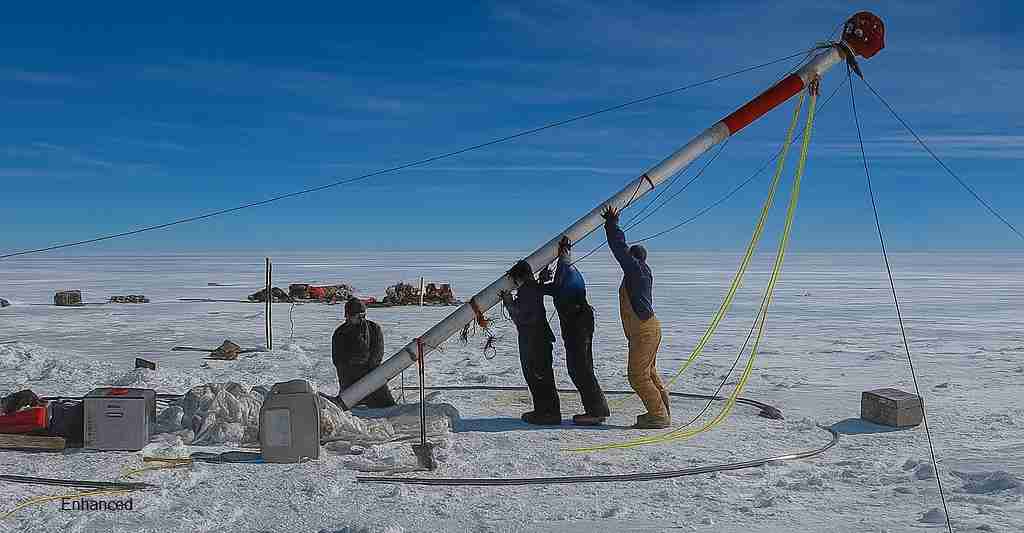
Scientists from COLDEX worked in the Allan Hills blue ice area, where strong winds and ice flow expose very old ice near the surface. The team used targeted field sampling and strict clean-handling procedures to preserve the ancient air bubbles trapped in the ice (Allan Hills blue ice area).
Dating the ice directly: argon isotopes and ancient air bubbles
Rather than relying on indirect stratigraphic matching, researchers measured argon isotope ratios preserved in the trapped air. This direct dating approach provides an age for the atmospheric sample and, by extension, the surrounding ice. See the WHOI press release and the peer-reviewed PNAS paper for methodology and results.
Why this beats previous records
Previous direct Antarctic ice records extended to roughly 1 million years. Estimates had placed possible older ice at Allan Hills up to ~3 million years; the new 6‑million‑year age more than doubles that record and pushes the direct climate archive well into the Miocene and Pliocene, periods with substantially different sea levels and temperatures.
What the ancient air bubbles reveal about Earth’s climate history
The trapped air supplies two lines of evidence: atmospheric composition (greenhouse gases) and temperature proxies (oxygen isotopes). Early analyses indicate a sustained cooling of Antarctica of about 12°C (~22°F) over the last 6 million years, documenting a long-term shift from the Miocene into the Pliocene (University of Maine analysis).
“These are the first direct atmospheric measurements from critical intervals millions of years ago. They let us test paleoclimate models against the real thing,” said project scientists.
Who led the research
The discovery team includes researchers from multiple institutions under COLDEX leadership. Project leaders named in the release include Sarah Shackleton of the Woods Hole Oceanographic Institution (WHOI) and John Higgins of Princeton University. COLDEX unites ice-core specialists, geochemists, and climate modelers to maximize the scientific yield.
Implications for climate science and modeling
This oldest-ice archive provides a baseline to validate paleoclimate models that simulate responses to greenhouse gases and orbital forcings. Direct atmospheric measurements from 6 million years ago will sharpen projections of ice-sheet sensitivity, sea-level response, and global temperature trajectories. In short, models can now be checked against an actual atmospheric record rather than inferred proxies alone.
Ongoing and future field work
COLDEX plans further expeditions to Allan Hills to retrieve longer and higher-resolution cores. Goals include building continuous records across more of the Miocene and Pliocene, refining dating techniques, and cross-checking argon isotope ages with complementary methods. Peer review and replication at other sites will be critical steps in confirming the full implications.
Implications for the United States of America
Economic impact: Improved climate models from direct ancient-air measurements can reduce uncertainty for businesses and insurers by improving sea-level and storm projections. Federal agencies, ports, and coastal industries will benefit from refined risk information.
Policy and political consequences: The findings offer technical evidence to inform long-term risk assessments and infrastructure planning. Clear communication will be important to translate scientific results into pragmatic adaptation policy.
National security and infrastructure: Defense and homeland security planners can use improved projections to prioritize investments that harden bases, ports, and supply lines against climate-driven risks.
Practical applications for Americans
Federal agencies such as NOAA, NASA, and the National Science Foundation can incorporate these records into national climate assessments. State and local governments can use improved projections when updating building codes, coastal setbacks, and disaster response plans. Private insurers and banks may adjust risk models for lending and pricing.
Source material and where to read more
Further reporting will track follow-up expeditions, peer review of the dating method, and the first detailed greenhouse-gas reconstructions from the sample. The Allan Hills find already marks a major step in exposing Earth’s deep climate past through the oldest ice Antarctica has yielded.