
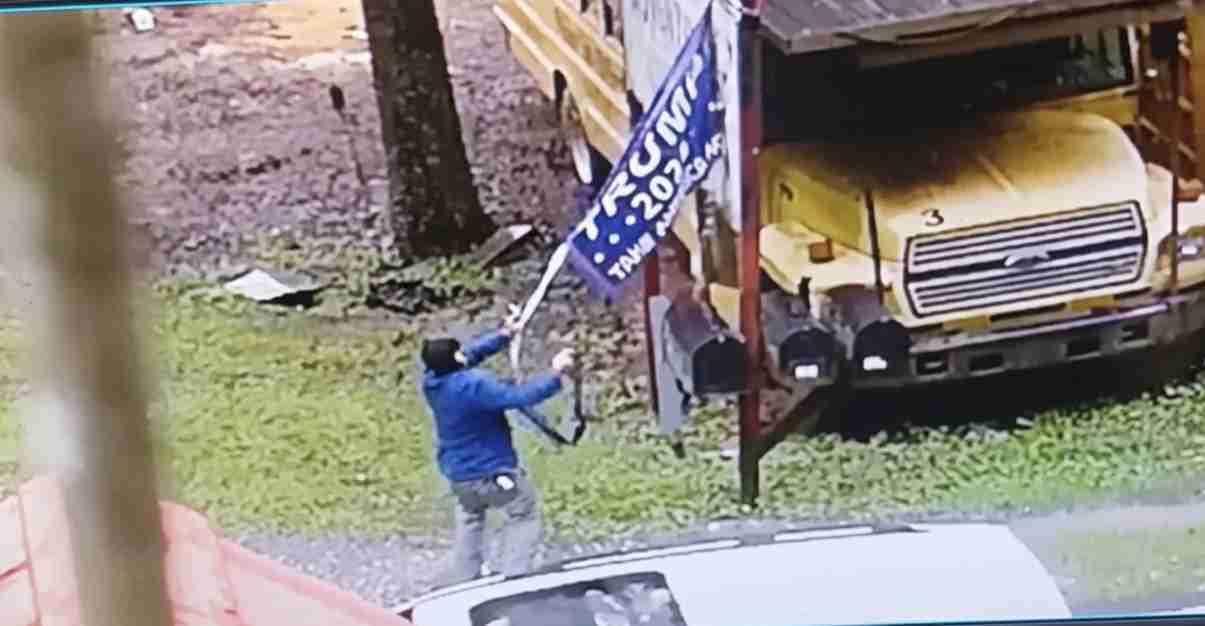
Trump banner torn from yard leads to gunfire in Swain County; homeowner says “some people just snap”
An incident in Swain County, North Carolina, escalated into gunfire after a pro-Trump banner was vandalized, turning property damage into a national headline and prompting debate over political tensions affecting local residents and communities nationwide.
- What happened: A pro-Trump banner was torn from private property and gunfire was exchanged; no one was hurt. Sources include The Washington Times, WLOS and WPDE.
- Who: Homeowner Ardis Thomas, 87, and her son Mark Thomas confronted accused vandal Benjamin Michael Campbell, 38, an accountant from Georgia.
- Legal status: Campbell was arrested in Cobb County, Georgia, extradited to Swain County and faces multiple felony counts; he was released on bond pending further proceedings.
What happened, step by step
Timeline: Security video shows the encounter began on Sept. 5, 2025, on Highway 19 West in the Nantahala Gorge, outside the Paddle Inn Rafting Company near Bryson City. The location and footage were described in reporting by WLOS.
According to The Washington Times and local law enforcement, 38-year-old Benjamin Michael Campbell drove a Jeep Cherokee past the property, then reversed, stopped, and exited the vehicle wearing a mask and cap. He approached the yard and tore down a large banner supporting former President Donald Trump; the act was captured on CCTV.
Mark Thomas, alerted by the noise and later reviewing the footage, retrieved a rifle and fired two warning shots into the air. Investigators say Campbell then fired back at the Thomases before fleeing the scene. No one was struck. The security footage was later posted online and circulated widely, including a clip available on YouTube.
Investigation and charges
Swain County deputies worked with Georgia law enforcement to identify the vehicle and suspect. Authorities reported that Campbell took steps to obscure his identity and obscure his vehicle’s plate, which suggested planning rather than a purely spontaneous act, according to WLOS.
Campbell was arrested in Cobb County, Georgia, extradited to Swain County and charged with multiple felonies, including assault with a deadly weapon with intent to kill, discharging a firearm to incite fear, and willful and wanton injury to personal property. Swain County Sheriff Brian Kirkland indicated additional charges may follow as investigators review video and witness statements. Reporting on the arrest and bond status was carried by WPDE and The Washington Times.
Community reaction and context
Ardis and Mark Thomas told reporters they had displayed pro-Trump signage on the property for nearly a decade without incident. Mark called the confrontation both “personal and political,” saying,
“He didn’t plan to stop and tear down my flag; it was just a spur-of-the-moment thing. Some people just snap.”
That quote was published in coverage by The Washington Times.
Local residents and officials described the episode as unsettling for a quiet, tourism-dependent area where the Paddle Inn Rafting Company serves visitors for kayaking and rafting. Coverage by WLOS emphasized the unwanted attention the incident brought to the Nantahala Gorge.
National angle: what this says about polarization
Criminal acts targeting political signs and banners have occurred nationwide as disputes over partisan symbols intensify. Experts note such acts can arise from impulse, anger or political disagreement; sometimes vandalism escalates to threats or violence. The Swain County episode — property damage quickly becoming a dangerous gun exchange — sits at that intersection, as described in national reporting by The Washington Times.
For readers and policymakers, the case raises legal and civic questions: when does protest or symbolic action cross into criminality, and when does the use of force amount to self-defense? The incident is likely to prompt discussions about deterrence, surveillance, and resources for rural law enforcement to handle politically charged conflicts.
Implications for the United States
Swain County political divide: A single act of vandalism in rural North Carolina reached national audiences, highlighting how local conflicts can amplify online and in cable news. Reporting by WLOS and The Washington Times framed the episode within those dynamics.
Gun violence and public safety: Though no injuries occurred, live gunfire in a rural community raises broader concerns about firearm use in disputes and the balance between gun rights and public safety, a point noted in coverage by WPDE.
Property rights and political expression: Yard signs and banners are common political expressions; their targeting tests tolerance and law enforcement response. The incident demonstrates how quickly vandalism can escalate into violence and fuel debates about protections for expression and private property.
The role of video and social media: Security footage and viral sharing were central to identifying the suspect and turning this into a national story. Video aided the investigation but also spurred debate about whether rapid dissemination inflames tensions; the footage is publicly available via YouTube and was cited by local outlets.
Reporting and sources
This report is based on law enforcement statements and reporting by Times Media Service partners and local outlets, including:
- The Washington Times
- WLOS — extradition and arrest coverage
- WLOS — CCTV and scene reporting
- WPDE
- Security video clip (YouTube)
- WGAA Radio (referenced link)
Note: All facts, names, dates and links above reflect reporting from the cited outlets and public records referenced in those stories.



