
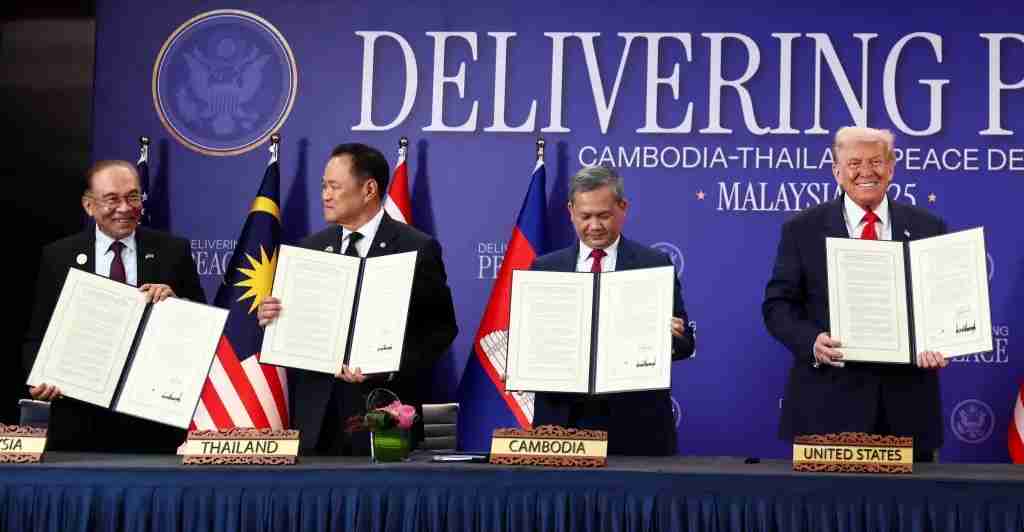
Trump acknowledged in peace push as Cambodia and Thailand expand ceasefire — but his presence at October signing remains unconfirmed
Former President Donald Trump received public recognition for diplomatic support in the 2025 Cambodia–Thailand border crisis and a Nobel nomination from Hun Manet; however, independent records do not confirm that Trump personally witnessed or brokered the October 26, 2025 signing.
- Malaysia led mediation and a July 28, 2025 ceasefire involved U.S. and Chinese envoys as co-facilitators.
- Hun Manet publicly said he would nominate Trump for the Nobel Peace Prize on August 7, 2025.
- Documentation does not show Trump personally brokering the July ceasefire or signing/witnessing the October 26 expanded agreement.
- Verification gaps persist: a circulating video claims Trump “presided over” the signing but lacks independent corroboration.
Background: how the crisis moved to a ceasefire
In mid-2025, sharp fighting erupted along sections of the Cambodia–Thailand border over long-simmering territorial disputes, displacing civilians and disrupting trade. Regional diplomacy intensified and produced formal steps toward de-escalation under international facilitation — see the detailed timeline in the 2025 Cambodian–Thai border crisis.
July ceasefire and mediation roles
July 28, 2025: A ceasefire was announced after talks led by Malaysia’s Prime Minister Anwar Ibrahim, with envoys from the United States and China acting as co-facilitators. Public summaries attribute the mediation leadership to Malaysia rather than to any individual foreign leader acting as an on-site broker.
August meetings and the 13-point framework
In August, a high-level meeting in Kuala Lumpur produced a 13-point framework aimed at immediate security and practical measures: stopping military provocations, protecting civilians, limiting troop movements near disputed zones, launching de-mining efforts and restoring basic cross-border trade.
Donald Trump’s acknowledged but limited role
On August 7, 2025, Cambodian Prime Minister Hun Manet publicly announced his intent to nominate Donald Trump for the Nobel Peace Prize, citing Trump’s diplomatic support during the process. That announcement is a recorded, public acknowledgement of Trump’s contribution as seen by Cambodia’s leadership.
What is not documented: available public records do not show that Trump personally brokered the July ceasefire or that he stood as a witness or signatory at the formal expanded agreement scheduled for October 26, 2025. Official accounts emphasize Malaysia’s mediation and involvement of U.S. and Chinese envoys, without naming Trump as an on-site negotiator or signatory.
Video claims, public messaging and verification gaps
A video clip with a headline saying Trump “presided over” the signing circulated online; however, the clip’s source and context are not fully documented in public summaries. The phrase “presided over” could mean symbolic endorsement, remote participation, or editorialized wording rather than physical attendance. Independent verification that Trump attended or brokered the October 26 event in person is currently lacking — view the circulating clip: video clip with a headline saying Trump “presided over” the signing.
Timeline of the key public steps
- Mid-2025: Border clashes erupt between Cambodia and Thailand. 2025 Cambodian–Thai border crisis
- July 28, 2025: Ceasefire agreed after Malaysian-led mediation; U.S. and Chinese envoys co-facilitate. 2025 Cambodian–Thai border crisis
- August 2025: Kuala Lumpur talks produce a 13-point framework to de-escalate and protect civilians. 2025 Cambodian–Thai border crisis
- August 7, 2025: Hun Manet announces intent to nominate Trump for the Nobel Peace Prize. 2025 Cambodian–Thai border crisis
- September 10, 2025: Expanded cooperation measures agreed, including removal of heavy weapons and resumption of trade. 2025 Cambodian–Thai border crisis
- October 26, 2025: A formal signing of an expanded ceasefire was scheduled; public records do not confirm Trump’s presence as a signer or witness. 2025 Cambodian–Thai border crisis
What the records do and do not show
Documented: Malaysia’s mediation, the July ceasefire, the August 13-point framework, continued talks involving multiple international actors, and Hun Manet’s public move to nominate Trump for a Nobel Peace Prize. 2025 Cambodian–Thai border crisis
Not documented: Clear, sourced public evidence that Donald Trump personally brokered the July ceasefire or that he witnessed or signed the formal October 26 expanded ceasefire agreement alongside Hun Manet and Thai Prime Minister Anutin Charnvirakul. A video claim exists but lacks independent corroboration in available public records. 2025 Cambodian–Thai border crisis • video clip with a headline saying Trump “presided over” the signing
Implications for United States of America
Economic impact
A sustained ceasefire can stabilize trade flows in Southeast Asia, reducing supply-chain disruptions that affect American exporters and shipping firms. Fewer interruptions mean lower costs and less volatility for U.S. companies operating in or sourcing from the region.
Political consequences
The episode feeds into debates over U.S. influence abroad. Supporters of engagement may point to U.S. diplomatic presence among co-facilitators as constructive leadership; critics will press for transparent records of who negotiated and witnessed agreements.
National security
A durable peace reduces the risk of escalation, limits openings for transnational criminal groups, and aligns with U.S. interests in maintaining regional stability without direct military involvement.
Social and humanitarian effects
A functioning ceasefire means fewer civilian casualties and displaced people, easing pressure on humanitarian networks and allowing NGOs to shift from emergency response to reconstruction and de-mining.
Cultural and diplomatic relations
Sustained peace can strengthen ties among Southeast Asian nations and outside partners, opening opportunities for cultural exchanges, business collaboration and academic partnerships that benefit U.S. institutions and communities.
Practical considerations for U.S. policymakers and the public
Policymakers should request clear records of negotiators and witnesses when leaders cite American support. Public assertions — including high-profile nominations such as Hun Manet’s stated Nobel intent for Trump — should be weighed against documented actions rather than symbolic gestures.
For businesses and humanitarian actors, the central practical question is whether security improvements are lasting enough to permit investment and sustained aid operations without recurring risk.
Sources and further reading
- Wikipedia entry on the 2025 Cambodian–Thai border crisis
- Video clip with a headline saying Trump “presided over” the signing (context not independently confirmed)
This article draws on public reporting and compiled timelines available as of the scheduled October 26, 2025 signing. Public sources acknowledge Donald Trump’s diplomatic recognition and Hun Manet’s Nobel Peace Prize nomination but do not provide independent confirmation that Trump personally witnessed or brokered the formal October signing.



