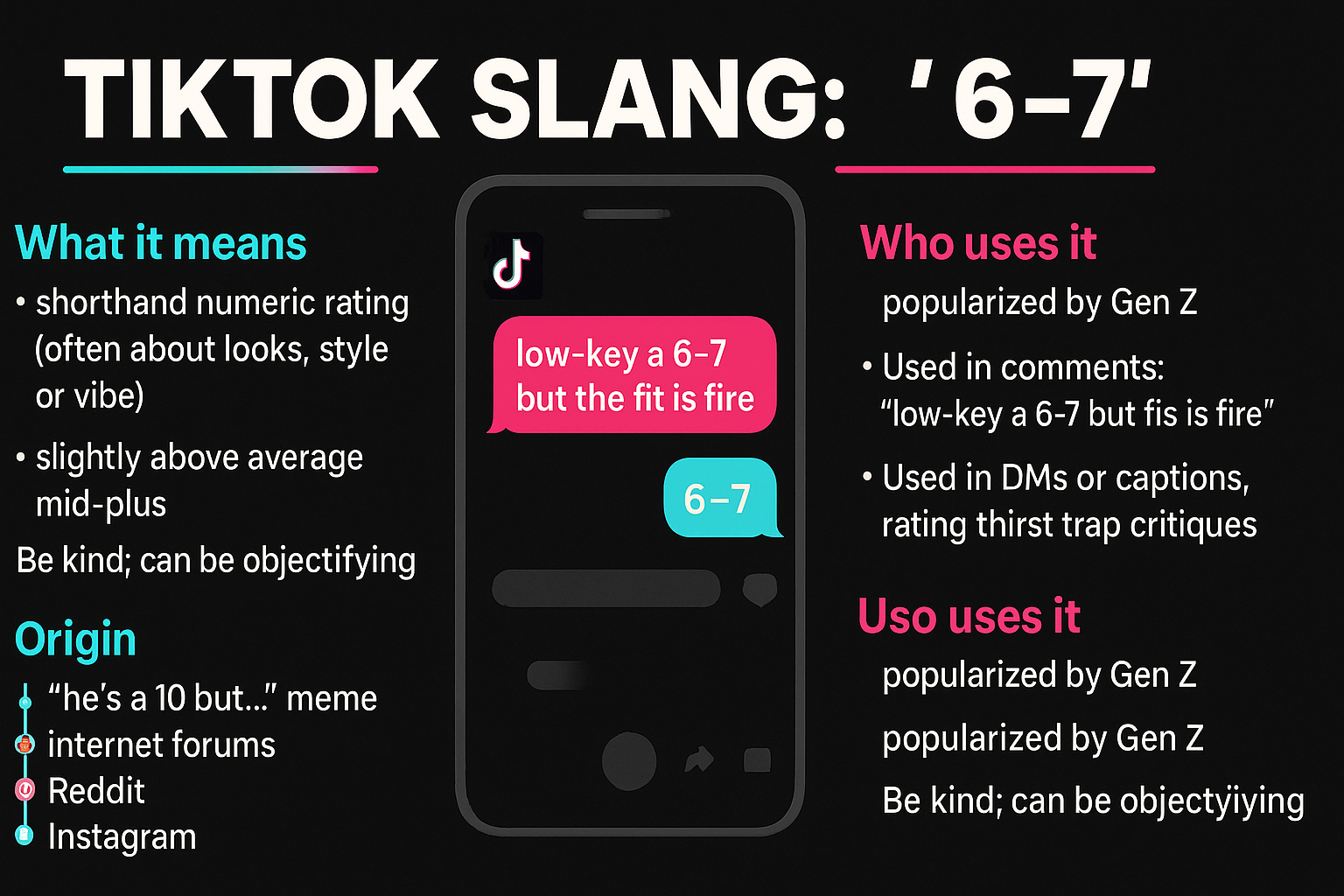
What “6-7” Means — How Skrilla’s “Doot Doot” Lyric Became Gen Z TikTok Slang
The internet is abuzz with “6-7,” TikTok slang from Skrilla’s late‑2024 song “Doot Doot (6 7).” The phrase morphed into a playful meme popular with Gen Z and Generation Alpha, often used jokingly or to signal height.
- Origin: A repeated hook in Skrilla’s “Doot Doot (6 7)” that became a loopable sound for short videos.
- Usage: A flexible, mostly nonsensical catchphrase — sometimes a joke about being “tall” or referencing 6’7″ players like LaMelo Ball.
- Spread: Viral edits on TikTok, Instagram Reels, Discord and Snapchat pushed the meme into sports and school hallways.
- Context: Harmless in tone; treated as an in-group marker rather than a politically charged term.
Origin and early spread
The phrase traces to the repeated hook in Skrilla’s song “Doot Doot (6 7)”, released in late 2024. The simple cadence made the lyric easy to loop, remix and layer under short-form videos, turning the hook into a memetic device used as a punchline or beat cue. (See: Wikipedia entry on the meme; FindMyKids explainer.)
Some posts suggested a nod to Chicago’s 67th Street, but that link isn’t firmly established. The meme’s momentum came mainly from its fit with TikTok editing — creators found it funny to place the clip over unrelated footage, following an established pattern of turning a hook into a catchphrase. (See: Wikipedia entry on the meme.)
How people use “6-7”
- Meme and challenge clips: Creators overlay the sample on short videos; the sound acts as a punchline or cue. (FindMyKids explainer)
- Sports edits: Highlights of players listed at 6’7″, like LaMelo Ball, use the phrase as shorthand for height or hype. (Wikipedia entry on the meme; Parade explainer)
- Comments and captions: Typed as a playful tag, sarcastic aside, or a quick in-group signal in threads.
- Physical mimicry: Hand gestures or chants timed to the beat appear in short performance-style clips.
Meaning is often intentionally thin
Unlike slang with explicit social meaning, “6-7” functions as a near-nonsense in-joke — a meme trigger relying on rhythm and shared recognition. Social observers compare it to earlier numeric memes (for example, “21” from Vine or “1738” from Fetty Wap): memorable numbers that act as quick social cues. (Parade explainer.)
Who is saying it and where
Usage is strongest among younger Gen Z and Generation Alpha on TikTok, but the meme crossed into Instagram Reels, Snapchat, Discord chats, and offline school settings. Reports of hallway chants and sports-team banter show the phrase moving beyond pure online circulation. (NorthJersey reporting; FindMyKids explainer.)
Comparisons with past numeric memes
Sociologists note numeric memes are efficient inside jokes: short, easy to replicate and set to music. The value is shared recognition rather than literal meaning; if you know it, you’re part of the joke. (Parade explainer.)
Adult reaction and school awareness
Most parents, teachers and school officials report mild curiosity rather than alarm. Tools that track online slang mark “6-7” as trending but not dangerous; educators treat it as a passing youth trend, occasionally seen in hallways or classroom social media feeds. (FindMyKids explainer; NorthJersey reporting.)
“6-7” and music-driven culture
The meme highlights how a single line in a song can become shorthand across platforms. For creators and influencers, the sound is a quick attention-grabber that signals humor or a punchline — and for musicians, viral use often boosts streams and visibility. (Wikipedia entry on the meme.)
Where to find more context
- Wikipedia: 6-7 (meme)
- FindMyKids explainer on slang meaning and use
- NorthJersey reporting on the trend
- Parade explainer on the phrase and similar memes
Implications for United States
Economic and cultural: The “6-7” meme exemplifies how social media fuels the music and creator economies — low-cost viral moments can increase streams for original artists and create short-term revenue for creators and brands. (Wikipedia entry on the meme; Parade explainer.)
Political and civic: The phrase carries no clear political meaning. For moderate conservative readers, it illustrates rapid cultural shifts on platforms like TikTok that often require policy focus on platform transparency and media literacy rather than policing specific slang. (FindMyKids explainer.)
Social effects: In classrooms and communities, “6-7” acts like other fleeting youth memes: it builds peer bonds and shared humor but is not associated with harmful behavior. Parents and educators should focus on digital literacy and open communication rather than alarm over a single catchphrase. (NorthJersey reporting.)
Cultural relevance for conservative-leaning readers
For moderately conservative readers, “6-7” underscores decentralized youth creativity and rapid cultural adaptation. Its harmless nature suggests many online trends are best met with community engagement and media-literacy guidance rather than censorship. (Parade explainer.)
Who should watch this trend
- Media teams and marketers interested in music-driven virality
- School leaders and parents monitoring youth culture
- Sports content creators leveraging short-form hype for highlights
- Music industry watchers tracking stream and visibility effects
Bottom line: “6-7” is a playful, low-risk meme born from a song hook that spread across Gen Z platforms; it’s cultural shorthand more than substantive slang, and its primary effect is social bonding and short-term attention.