ICE director says Portland facility has faced 100+ nights of violence; federal agencies target Antifa-linked groups as Trump announces 200 National Guard troops for Portland
ICE officials say Portland’s ICE facility endured over 100 consecutive nights of violence, including doxxing of employees and targeted attacks, prompting a coordinated federal response and President Trump’s plan to deploy 200 National Guard troops to support immigration authorities.
- More than 100 consecutive nights of attacks on the Portland ICE office with tactics like bottle rockets, lasers, rocks and barricades — according to AOL News.
- Doxxing and intimidation: At least six employees reportedly had personal information posted and some were followed home — a development federal officials call targeted harassment (AOL News).
- Multi-agency federal response: HSI, FBI, ATF, DEA, IRS and ICE are coordinating criminal investigations into groups allegedly linked to Antifa organizing (AOL News), while federal prosecutors have filed charges in at least one case (DOJ).
- 200 National Guard troops: President Trump announced plans to send Guard troops to bolster security around the ICE facility and protest zones (AOL News).
Nightly violence at Portland ICE facility
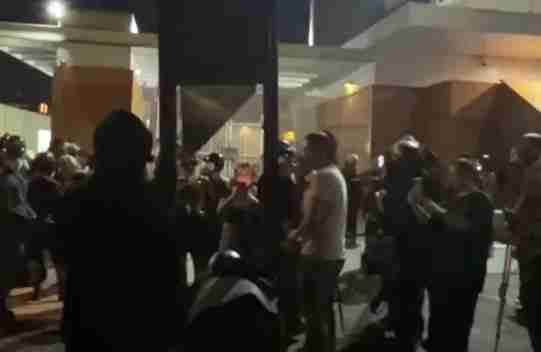
ICE officials characterize the incidents outside the Portland facility as a sustained campaign rather than isolated protests. Director Cammila Wamsley described repeated attacks including bottle rockets, rocks shattering windows, lasers aimed at officers’ eyes, paint thrown on property and barricades used to block vehicles — details reported by AOL News.
Wamsley said groups “dressed in all black” often arrive after dark with the intent “to wreak havoc,” and crowds can swell rapidly from dozens to hundreds, overwhelming the limited federal staff on site. She noted the ICE office sometimes has as few as ~20 officers available to protect the building and staff, creating difficult security dynamics (AOL News).
“It is frustrating for us to watch people be attacked on the street and know that we don’t have the authority to be able to really step in unless there’s some nexus to federal law,” Wamsley said.
Doxxing and targeted intimidation
Federal officials highlighted a troubling trend: at least six ICE employees have reportedly had personal information posted publicly — and some were followed to their homes. Officials describe this as crossing a line from property damage and protest into targeted intimidation (AOL News).
Local police response
Wamsley criticized the Portland Police Department for often not intervening at the ICE site. She said federal officers are limited to responding when a federal crime is involved and that local police seem to follow different guidelines near the ICE office, an approach Wamsley partly attributes to political directives from city leaders (AOL News).
City officials and police leaders have defended policies that limit certain tactics and emphasize de-escalation during protests, arguing aggressive interventions can inflame tensions. That defense, however, is now a central element in the debate over protection of federal workers and facilities.
Federal response and multi-agency coordination
Multiple federal law enforcement agencies report coordinating to investigate what they describe as organized efforts to target the ICE office. Todd Rignel, an assistant special agent with Homeland Security Investigations in Oregon, said groups linked to Antifa are under investigation for organizing the attacks, and that the response includes the FBI, ATF, DEA, IRS and HSI working alongside ICE (AOL News).
Federal officials are using criminal investigations, intelligence collection and prosecutions when evidence supports charges. For example, federal prosecutors charged at least one Portland woman in connection with an assault near the ICE office (DOJ announcement).
National Guard Portland deployment
President Donald Trump announced plans to send 200 National Guard troops to Portland to support immigration authorities and provide added security around protest areas, according to reports (AOL News).
Officials say Guard troops would be positioned near protest zones to back up federal operations and secure areas around the ICE facility. Supporters argue the Guard provides a visible deterrent and frees other law enforcement resources; critics warn that military troops near civilian protests could escalate tensions or blur lines between policing and military involvement.
Broader context of anti-ICE violence
Portland’s unrest aligns with a national pattern of threats and attacks on ICE facilities. Federal officials pointed to a deadly September 24 incident in Dallas where gunfire at an ICE facility left two detainees dead and another hospitalized; shell casings reportedly carried an “ANTI-ICE” message — a development that heightened federal concerns about risk to immigration facilities and staff (AOL News).
Operational challenges
Rapid crowd formation and the speed of nightly escalations create major security hurdles. Wamsley emphasized that a small federal presence cannot safely defend the facility if a crowd grows from dozens to hundreds in minutes. ICE says it must balance staff protection, property security and restraint to avoid inflaming protests further (AOL News).
Despite risks, ICE leadership says staff will continue operations while federal prosecutors pursue charges against individuals who commit crimes or assault officers during protests (DOJ).
Implications for the United States
Law and public safety: The Portland case raises questions about federal-local coordination in protecting federal facilities and personnel. If similar tactics spread — rapid crowding, doxxing and targeted attacks — federal authorities say they will increase joint investigations and seek prosecutions where warranted.
Politics and governance: The clash over police responses has political consequences. Local leaders emphasizing limited intervention face criticism from federal officials and some national lawmakers, while increased federal or Guard presence may draw civil liberties concerns.
Security policy: Multi-agency tasking and potential Guard deployments could become a model for protecting federal facilities, but depend on clear legal authority and sustained interagency cooperation.
Social cohesion: The doxxing of federal workers and threats to their homes raise concerns about personal safety and the limits of protest, potentially prompting expanded legal tools and criminal enforcement to deter violence.
Practical effects: Continued protests and increased federal security may cause street closures, disruptions to downtown businesses and heightened law enforcement visibility that affect residents and visitors.