
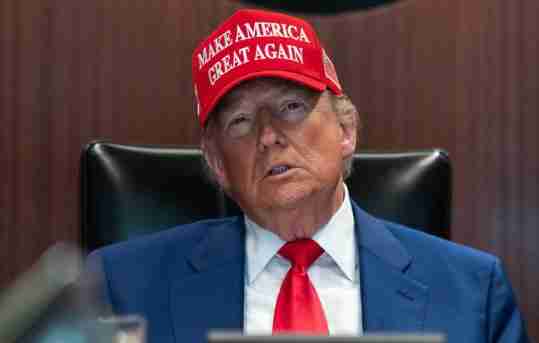
President Trump declares a “complete and total ceasefire” after 12 days of intense conflict, as both nations agree to staged pauses in hostilities
 Donald Trump / Israel and Iran complete and total ceasefire (Courtesy Wikipedia)
Washington, DC (Times Media Service) – In a groundbreaking announcement on June 23, 2025, President Trump declared that Israel and Iran have agreed to a complete and total ceasefire, bringing a tentative end to the 12-day air war that threatened to ignite a wider Middle East conflict. Under the staged agreement, Iran would halt strikes at midnight Tehran time, followed by Israel ceasing operations 12 hours later.
Details of the Ceasefire Agreement
The ceasefire unfolds in two coordinated 12-hour phases. First, Iran agreed to stop missile launches against Israeli targets from 12:00 a.m. local time on Wednesday. Twelve hours later—midday in Israel—Israeli forces were to suspend their airstrikes on Iranian military sites. President Trump emphasized that any violation by either side would constitute a “major breach” of the deal, warning Israel explicitly: “Bring your pilots home, now!”
Negotiations were facilitated by back-channel communications involving U.S. national security officials in coordination with Israeli Prime Minister Benjamin Netanyahu and Iran’s Foreign Ministry. Iran’s envoy, Abbas Araghchi, publicly affirmed that as long as Israel respected the deadline, Tehran would keep its promise. Israel’s Defense Minister, however, had warned of a forceful response should Iran fire any additional missiles.
Reactions from U.S. and World Leaders
Senior U.S. officials hailed the ceasefire as a diplomatic win after direct U.S. involvement in strikes on Iran’s uranium-enrichment facilities. Secretary of State Anthony Blinken described the pause as “a necessary step to prevent further civilian casualties on both sides.”
European allies expressed cautious optimism. French President Emmanuel Macron called on both nations to use the lull to pursue long-term peace talks, while British Prime Minister Rishi Sunak praised the U.S. for brokering the deal but urged restraint from all parties. Russian Foreign Minister Sergey Lavrov warned that the ceasefire must lead to concrete negotiations or risk rapid unraveling.
Verification and Challenges on the Ground
Despite the high-profile announcement, verifying the ceasefire’s true status proved challenging. Satellite imagery from private firms monitored potential missile sites in central Iran, while Israeli surveillance drones patrolled southern regions for any inbound threats.
On the morning after the deadline, Israeli military spokespeople initially reported that Iran had launched rockets near Beersheba, killing four civilians—an assertion Tehran denied, attributing the strikes to rebel groups aligned with neither government. President Trump intervened via Truth Social, ordering Israel to “DO NOT DROP THOSE BOMBS. IF YOU DO IT IS A MAJOR VIOLATION,” thereby calming fears of renewed escalation.
Economic Impact and Market Response
Financial markets reacted swiftly to reduced Middle East risk. The Nasdaq 100 surged to record highs, lifting the S&P 500 and Dow Jones Industrial Average by over one percent. Oil benchmarks Brent and West Texas Intermediate plunged nearly seven percent intraday, as traders anticipated a drop in risk premiums for crude.
Analysts noted that Trump’s hints at easing sanctions on Iranian oil added downward pressure on prices. While some strategists warned that any resurgence of hostilities could reverse gains, many remained bullish on U.S. equities, citing robust domestic growth figures and expectations of Federal Reserve rate cuts later in the year.
Humanitarian Concerns and Civilian Impact
Twelve days of strikes had displaced thousands of civilians on both sides of the border. Israeli towns in the Negev faced repeated rocket barrages, prompting evacuations, while Iranian border provinces endured heavy aerial bombardment targeting underground facilities.
Humanitarian organizations in Israel and Iran prepared to deliver emergency aid once safe corridors were established. The International Red Cross called the ceasefire “an essential but fragile respite,” urging both governments to allow unhindered access for medical supplies and water.
Reaction in the United States
Across the U.S., responses split along partisan lines. Republican lawmakers lauded President Trump’s decisive leadership, framing the ceasefire as evidence of restored U.S. strength abroad. Some hawkish voices, however, questioned whether halting strikes so soon risked undermining long-term security goals.
Democratic critics argued that the deal reflected short-term optics rather than sustainable peacebuilding. Senator Elizabeth Warren warned that absent a broader diplomatic framework, the pause could collapse, dragging the U.S. back into another Middle East quagmire.
Impact of the Israel and Iran Complete and Total Ceasefire on U.S. Nationwide Sentiment
Americans nationwide breathed a collective sigh of relief at the prospect of de-escalation in the Middle East. News outlets reported upticks in consumer confidence polls, and talk-show hosts debated what the agreement meant for U.S. foreign policy heading into an election year.
Veteran service members and veterans’ groups emphasized the need to care for troops still stationed near conflict zones, urging Congress to fund additional support and mental-health resources. Meanwhile, universities across the country hosted forums on the crisis, reflecting deep public interest and concern.
Hanna Crosby / Economic and Political Strategist Writer (Times Media Service)
SoCal economic & political strategist, business consultant, and journalist covering fiscal policy and community impact.
hcrosby@timesmediaservice.com



