
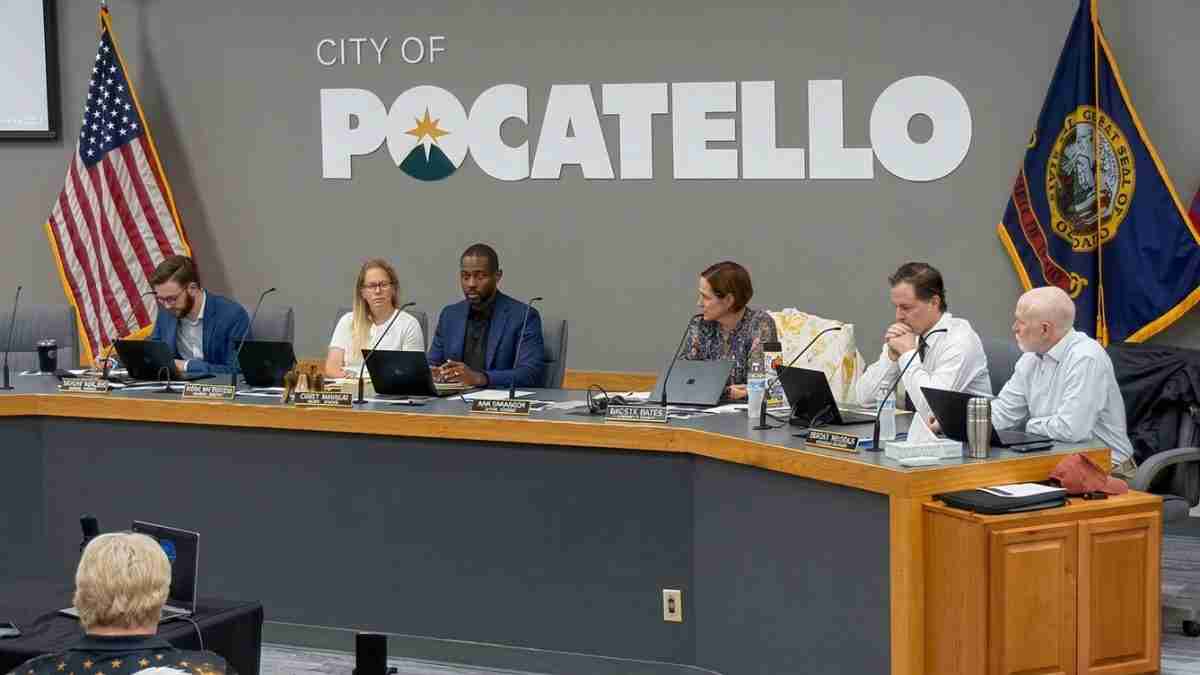
POCATELLO, Idaho, Aug. 16 (Our Idaho Times) — The Pocatello City Council is considering whether the city’s automated license plate reader program provides enough public-safety value to justify its privacy and data-sharing concerns.
At an Aug. 13 work session, Pocatello police officials and Flock Safety representative Sheerica Ware answered council members’ questions about how the cameras work, who can access the data and how long records are kept. The council agreed that the program needed more discussion. A follow-up work session is expected, but the city has not announced a specific date.
The session did not include formal public comment.
What do the cameras do?
Automated license plate readers, or ALPRs, capture images of vehicles and license plates. Police can use the records to look for vehicles connected to an investigation, such as a stolen vehicle, a hit-and-run or another reported crime.
Pocatello police Capt. Zac Bartschi said the system is intended to give investigators leads and help establish probable cause. He said it does not replace police investigation or officer judgment.
Bartschi also said the cameras do not use facial recognition, identify drivers, track cellphones, issue speeding or red-light citations, or record conversations.
Police officials cited cases in which the system helped with stolen-vehicle, hit-and-run and other investigations. But the council was not given a complete list of cases, court records or independently verified data showing how often the cameras led to arrests, charges or convictions.
Council President Corey Mangum said the city should obtain clearer results data, including the number of serious offenders identified through the system. That information could help the council judge whether the program is effective, rather than relying only on individual examples.
How did Pocatello get the system?
Pocatello police evaluated several vendors in 2024, including Neuology, Motorola, Rekor and Flock Safety, before selecting Flock, according to the police presentation described at the work session.
The Idaho State Journal reported that the department spent $102,000 in December 2024 to purchase 34 readers and began using them in early 2025. Other reports put the number of cameras in Pocatello at 36. The supplied city records do not resolve the difference.
The council approved the Flock contract, with Councilman Hayden Paulsen reported as the only opposing vote. Public reports differ on whether the approval occurred in 2024 or May 2025.
Paulsen has continued to oppose the program. Before the work session, he said concerns about reported abuses of Flock systems elsewhere raised privacy issues and that he wanted the contract reviewed.
Who can see the information?
Police Chief Roger Schei said Pocatello recently disabled nationwide search access to its system. Regional law-enforcement partners may access the system under department rules, while national access is limited to the National Center for Missing and Exploited Children and the FBI, according to Schei’s presentation.
Other agencies must request access and provide a reason and case number, police officials said. Schei also said Pocatello does not share camera data for immigration-enforcement purposes and has conducted no searches solely for immigration purposes. He said requests from Immigration and Customs Enforcement generally involve a criminal matter.
Those statements describe department policy and practice; the city did not present access logs or an independent audit at the work session.
Ware said Pocatello owns the data collected in the city. She said Flock uses anonymized, aggregated metadata to improve its system and limits access to trained personnel who meet Criminal Justice Information Services standards.
How long is the data kept?
Police officials told the council that camera reads are automatically deleted after 30 days unless they are tied to evidence or an official case report. Records connected to a case can be kept indefinitely under that policy.
The Idaho State Journal reported that Flock announced Aug. 13 that it would shorten its standard retention period to seven days. It remains unclear whether that change applies to Pocatello, when it would take effect or whether the city’s contract would need to be changed.
The city’s contract, any amendments and the department’s detailed ALPR policy were not supplied at the session materials described in the reports. As a result, the public record available for the discussion does not establish the program’s total contract term, renewal terms, cancellation provisions or recurring costs.
Why is the program controversial?
Supporters say ALPRs can help police find stolen vehicles and investigate crimes more quickly, especially in Pocatello, which police describe as a regional transportation hub near state borders. The cameras can provide information about a vehicle’s location and travel history without requiring an officer to be present when the vehicle passes.
Critics, including Idaho organizer Brian McKellar and the group Deflock Idaho, have characterized Flock systems as mass surveillance and questioned whether their use complies with Idaho law. Those claims have not been resolved by a court ruling, legal complaint or official legal opinion supplied for the council’s discussion.
The central policy question is not only whether a camera can help solve a particular crime. It is also how broadly the information can be searched, how long it remains available, what safeguards govern outside access and whether the city can measure the program’s results.
The council’s next discussion is expected to focus on those issues, as well as the department’s policies and the Flock contract. Whether the council changes the program, limits it or ends the contract has not been decided.



