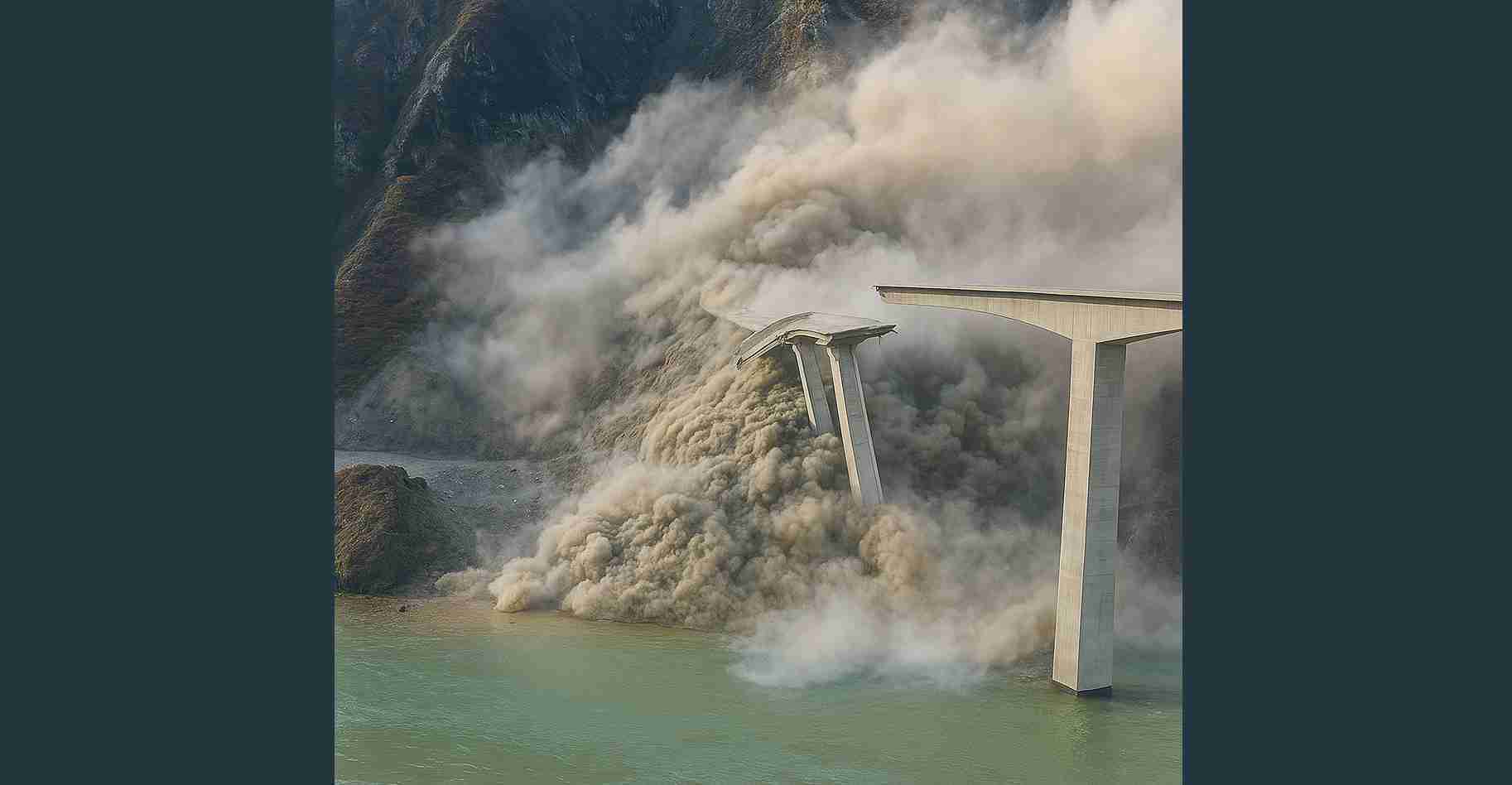
Hongqi Bridge collapse in Sichuan: 758‑metre span falls into river after landslide
A 758‑metre highway span, the Hongqi Bridge in Sichuan Province, collapsed into a river after a massive landslide undermined its supports days after cracks appeared; authorities had closed the bridge beforehand and reported no casualties.
- Preemptive safety action: Officials closed the bridge after detecting terrain cracks, a move credited with preventing injuries.
- Cause appears geological: Videos show a sudden slope failure that engulfed supports, suggesting a landslide-triggered collapse rather than pure structural failure.
- Newly opened link: The bridge had been completed earlier in 2025 as part of a highway connecting central China and Tibet, raising oversight questions.
- Investigations launched: State and local authorities have closed the site and initiated technical reviews of design, construction and monitoring records.
What happened: collapse captured on video
Authorities and eyewitnesses report that a major landslide struck the mountain slopes supporting parts of the Hongqi Bridge, causing a section of the 758‑metre span to break away and plunge into the ravine. Multiple videos show dust and earth racing down the slope and impact on girders and concrete, which then collapsed into the river below (see video and video).
“Visible ground movement and cracks were detected the day before; the bridge was closed as a precaution and later failed when the slope gave way,” local reports and video statements indicate.
Timeline and early warnings
Footage and local reporting indicate instability signs emerged at least one day before the collapse. Observers noted cracks in nearby slopes and on access roads; officials barred vehicles and people from the bridge as a precaution. The following day, a major landslide undermined a supporting base and caused the structure to break and fall (see video).
Engineering, geology and risk factors
Investigators will examine multiple contributing factors. In Sichuan, steep slopes and fractured soil or rock make landslides a recurring hazard. Potential risk drivers include:
- Natural triggers: heavy rain, seismic activity, seasonal thaw or permafrost changes.
- Construction and disturbance: newly altered slopes, rapid excavation or insufficient geotechnical mitigation.
- Design and monitoring: the adequacy of foundation design, retaining works and sensor-based monitoring systems.
Early footage points to a ground‑failure event that reached the bridge supports rather than an isolated failure of steel or concrete, but full technical analyses will be required to assign responsibility.
Official response and investigations
Chinese authorities have cordoned the site and announced an investigation. State and local technical teams are expected to coordinate inspections, review construction records and analyze any monitoring data from before and after the bridge opened. Public statements emphasize the lack of casualties and that emergency access and inspections are underway (see video and reporting from The Independent).
Local and national significance
The Hongqi Bridge was a strategic link intended to improve travel between central China and Tibet. Its abrupt failure months after opening raises questions about geotechnical site selection, oversight during construction and post‑completion monitoring. Officials will likely face pressure to review similar projects in other landslide‑prone provinces.
Media and public reaction
Dramatic footage circulating on social platforms and international outlets focused attention on the visuals and on the bridge’s recent completion. Coverage has highlighted how preemptive safety measures — closing the bridge after cracks appeared — likely prevented injuries.
Implications for the United States
Economic: The collapse underscores risks in building large infrastructure in challenging terrain; US companies and planners may reassess supply‑chain and investment risk. Political: The incident feeds debates about independent inspections, geotechnical assessment and accountability for public projects. Social: Public trust in fast‑tracked projects can erode, while the effectiveness of early warnings and closures may spur calls for better monitoring.
Practical applications for US residents and policymakers
- Invest in monitoring: expand sensors, remote sensing and regular geotechnical surveys for vulnerable infrastructure.
- Strengthen inspection regimes: require independent third‑party reviews for high‑risk projects in steep terrain.
- Update emergency protocols: drill and refine evacuation and closure procedures — the preemptive closure here prevented casualties.
- Reassess funding priorities: balance rapid construction with sufficient site studies and long‑term maintenance funding.
Sources
- video — footage cited in multiple reports
- video — additional footage of the collapse and official statements
- reporting from The Independent
Authorities in Sichuan continue technical inspections. Engineers and geologists will need access to design records and site data to determine the mixture of geological forces and engineering factors that led to the Hongqi Bridge collapse. The outcomes will inform planning, oversight and protection measures for projects in landslide‑prone regions worldwide.