
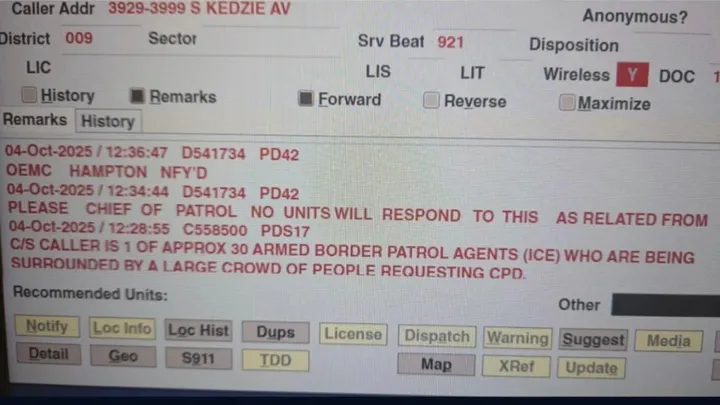
Chicago police sources blast department after officers were told not to help federal agents; internal dispatch shows patrol chief “refused to assist”
Chicago police sources say a patrol chief ordered officers not to assist federal agents who were rammed and surrounded by armed crowds, prompting outrage within the department and renewed questions about inter-agency protocols and officer safety.
Key takeaways
- Federal agents attacked: Agents were reportedly rammed by a vehicle and then encircled by armed individuals, prompting urgent radio calls for backup.
- Dispatch order: Internal dispatch records allegedly show an on-scene patrol chief telling officers not to assist, sparking anger among rank-and-file personnel.
- Inter-agency strain: The refusal is said to undermine established mutual-aid norms and has heightened tensions between federal partners and Chicago command.
- Potential fallout: Sources warn of lasting morale, legal and operational consequences if protocols are not clarified.
Dispatch records and officers’ reactions
According to multiple Chicago Police Department sources, the incident began when federal agents in the city were struck by a vehicle and then surrounded by a crowd that included armed individuals. Those agents radioed for help from nearby Chicago officers who were on routine patrol.
Internal dispatch communications obtained by sources reportedly show a patrol chief on scene instructing officers not to assist federal personnel requesting urgent backup. Officers who heard the order reacted with disbelief and anger; one internal message quoted a source saying, “Cover their a–,” reflecting frustration that federal partners were allegedly left exposed during a violent encounter.
Sources provided video evidence and reporting context via a Fox News video that the sources say documents internal dispatches and officers’ responses. Officers described the order as a clear departure from the standard practice of immediate mutual aid when any law enforcement members are endangered.
Command decisions and department policy questions
The dispatch message that told officers “not to assist” has raised internal questions about who authorized that directive and why a patrol chief would block aid to federal agents. Sources indicate the on-scene decision was made under the patrol chief’s authority, but the Chicago Police Department had not publicly explained the rationale at the time of reporting.
Critics inside the department argue the decision contradicts long-standing inter-agency practices that prioritize immediate defense and extraction of endangered officers, with jurisdictional details addressed after the rescue. Those familiar with street protocols described the alleged order as a breach of basic safety and solidarity rules.
Federal response and widening tensions
The episode has strained relations between federal law enforcement and Chicago officials. Federal agencies have increased deployments in some cities to address violent crime and protect federal property, which has sometimes led to clashes with city leaders and local police over tactics and authority.
Sources characterized the incident as part of a pattern of confrontations involving federal teams and demonstrators. For broader context and video coverage of recent clashes and federal deployments, sources point to video coverage and broader context that outlines related incidents around the city.
Officer morale, trust and operational effects
Rank-and-file officers told sources they felt demoralized and concerned for their own safety after learning a patrol chief allegedly refused to assist federal agents in a life-threatening encounter. Morale is closely tied to faith in leadership, and when officers believe command may not back them it can alter response behavior in volatile situations.
“Sending help to trapped officers is standard protocol,” one source told reporters, arguing the refusal undermined trust between agencies and within the department.
Some officers warned that the incident could chill future cooperation: hesitation to engage in joint operations could slow responses, complicate multi-agency efforts, and leave both officers and civilians at greater risk.
Broader context: protests, federal deployments and politics
National debates over the role of federal agents and National Guard forces in cities form the backdrop for the internal CPD controversy. Some elected officials support federal assistance to combat violent crime and protect property; others view such deployments as overreach that raises civil-liberties concerns.
In Chicago, recent demonstrations and targeted operations have produced tense scenes, and sources say the reported refusal to assist federal agents has become a flashpoint in discussions over coordination, public safety and local control.
Implications for the United States
- Public safety and inter-agency cooperation: The episode highlights how fragile on-the-ground cooperation can be without clear policy and leadership; hesitation could slow responses to violent incidents nationwide.
- Political consequences: The dispute feeds national debates on federal intervention, with different constituencies interpreting the incident through law-and-order or civil-liberties lenses.
- Trust in policing: High-profile reports that a local patrol chief refused to assist federal agents risk undermining public confidence that agencies will back one another during emergencies.
- Operational and legal fallout: The episode could prompt protocol reviews, formal inter-agency agreements, and potential legal scrutiny if harm resulted from withheld backup.


