
Pacemaker data helps narrow Nancy Guthrie missing Tucson timeline — what the devices can and cannot tell investigators
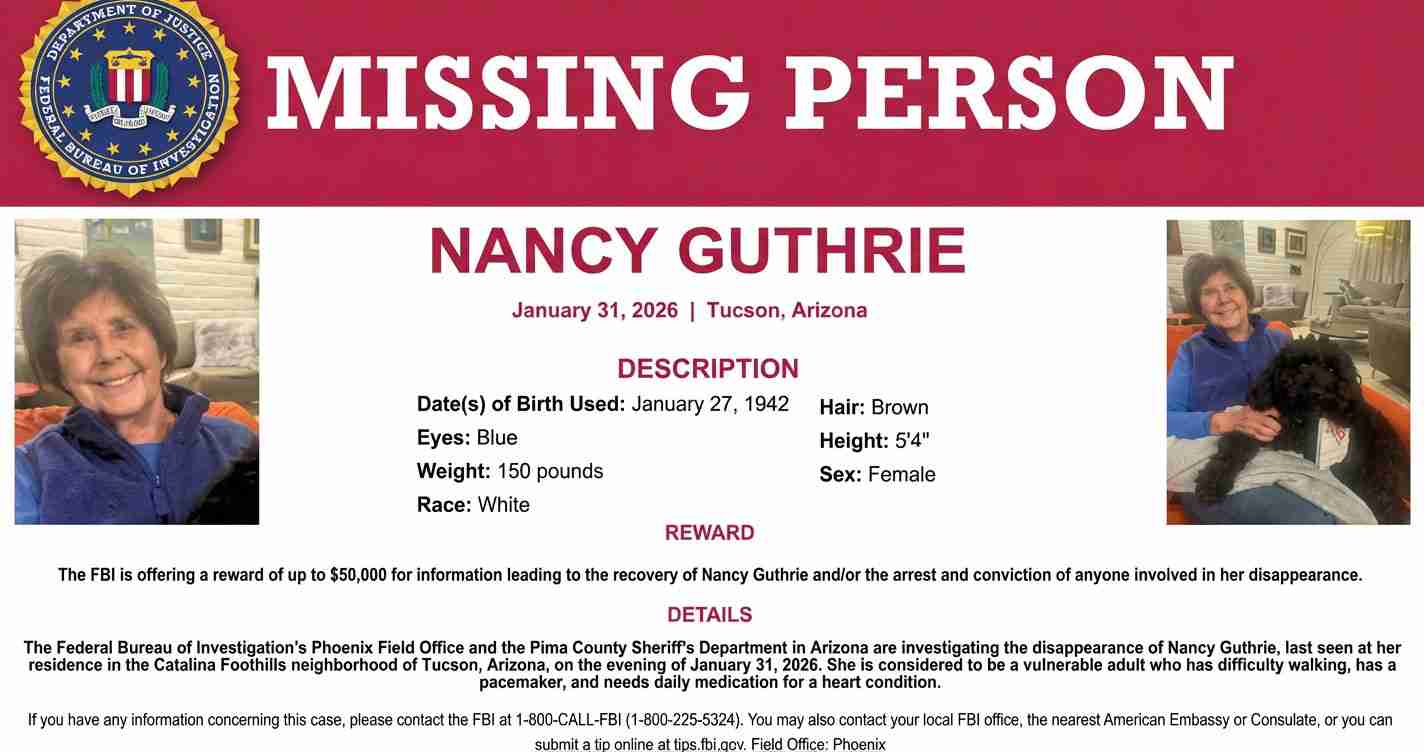
Nancy Guthrie, mother of “Today” co-host Savannah Guthrie, vanished from her Tucson home on Feb. 1, 2026. Investigators cite a pacemaker app disconnection at about 2:28 a.m. as a central timing marker while the FBI pursues leads.
Key takeaways
- Pacemaker app disconnected at ~2:28 a.m. — investigators say this helps narrow the early-morning window.
- Surveillance and doorbell footage show activity before the disconnection; the FBI later released images of a person of interest and additional video.
- Ransom demands in Bitcoin were sent to local outlets; a small transfer tied to a listed wallet was recorded but not confirmed as linked to the disappearance.
- The pacemaker logs timing, not location. Investigators are combining device records with video, phone records and physical evidence.
Pacemaker data: what it shows and where its limits lie
Pacemakers are small, battery-powered implants that sense heart rhythm and deliver electrical impulses when needed. Modern devices often pair with phone apps or home monitoring units so clinics receive alerts about serious cardiac events.
Investigators say Guthrie’s pacemaker remained functional after the app disconnection, but remote monitoring ceased when the device lost its link to the phone at about 2:28 a.m.. That loss of connectivity does not stop the pacemaker from pacing; it only prevents clinics or caregivers from receiving real-time data and alerts.
Reporting on the investigation is available from KOMO/Komonews, which details the device disconnection and related footage.
What investigators can learn
When accessible, a pacemaker’s stored logs can show heart-rate trends and certain cardiac events. In missing-person probes, those records can:
- Help establish whether a subject was stressed, injured, or suffered cardiac arrest.
- Narrow the timeframe of events by showing when monitoring stopped or when specific cardiac events occurred.
- Be combined with other forensics (video, phone records, physical evidence) to refine hypotheses about cause and sequence.
Cybersecurity analysts and digital-forensics experts note that pacemaker logs can be especially useful for timing but must be validated and interpreted carefully; see analysis cited in broadcast reporting from a cybersecurity expert in a Fox News segment.
What pacemakers cannot do
Pacemakers do not provide GPS or location data. They record cardiac metrics, not coordinates. A phone app can transmit alerts while connected, but it cannot be used as a tracker to follow a person’s movements. That limitation means investigators must pair device logs with other sources to reconstruct events.
“Device connectivity is one piece of a broader puzzle,” said analysts discussing the probe and device limitations.
The timeline investigators are building
Authorities have assembled a sequence from surveillance timestamps, device activity and welfare checks:
- ~9:50 p.m. (Feb. 1) — Guthrie returned home and closed her garage after dinner at her daughter’s house (neighborhood camera timestamps, KOMO/Komonews).
- 1:47 a.m. — The home’s doorbell camera lost its connection; about 25 minutes later automated surveillance flagged movement near the property. Investigators later recovered additional backend clips despite subscription complications.
- ~2:28 a.m. — Pacemaker disconnected from Guthrie’s phone app, ending remote monitoring capability while not affecting pacing function (KOMO/Komonews).
- Late morning — Friends reported she missed a regular virtual church service; relatives conducted a welfare check and 911 was called about 12:03 p.m.; deputies arriving shortly after found blood on the front porch.
Investigators note roughly a 41-minute span between reported doorbell-camera interference and the pacemaker disconnection — a window they view as crucial in determining events that morning (expert commentary).
Ransom notes, bitcoin and persons of interest
Days after Guthrie vanished, ransom notes demanding payment in Bitcoin were sent to local news outlets. Her family publicly offered to cooperate with investigators and consider payment, but authorities have not confirmed the notes’ authorship or connection to the disappearance.
Investigators recorded a small Bitcoin deposit tied to a listed wallet; its significance remains under review. The FBI released video showing a gloved person obstructing a camera with plants and a backpack; a delivery driver briefly detained as a person of interest was released without charges after searches. The FBI has posted a $50,000 reward for information (KOMO/Komonews, FBI-released footage).
Expert perspectives and caveats
Cybersecurity and digital-forensics experts stress careful handling and validation of implantable-device data. While pacemaker logs can indicate spikes, drops or pauses in heart rate, they do not show who was present, location, or the external cause of injuries. Remote monitoring depends on connectivity — via app or home base unit — and a lost connection is only one data point.
Past instances where implantable-device records informed investigations demonstrate their value for timing events, but outcomes vary by device manufacturer, retrieval method and context. Investigators in this case are combining pacemaker logs with recovered video, phone records and physical evidence to avoid over-reliance on any single source.
Implications for United States
Economic: High-profile cases can spur calls for investment in digital-forensics units, camera infrastructure and cybersecurity resources.
Political: The FBI’s involvement and reward highlight federal-local cooperation; the case may prompt cross-partisan attention to public safety resourcing.
Social and cultural: The disappearance underscores how household technologies, medical implants and surveillance intersect with personal safety and media scrutiny. Families may reassess monitoring practices for older relatives.
Practical: Clinicians and caregivers should ensure device apps and home monitoring units are up to date and emergency contacts are registered. Law enforcement should combine pacemaker logs with other forensic sources when reconstructing events.
Sources and reporting notes
This article draws on reporting and public materials including:
- KOMO/Komonews coverage of the investigation
- FBI-released footage and media briefings (video summary)
- Cybersecurity expert analysis from broadcast coverage
Investigators continue to urge anyone with information to contact the Pima County Sheriff’s Department or the FBI. The probe remains active; officials say they are following all leads, including the pacemaker data timeline and related digital and physical evidence.



